Five Things You Never Knew About the Declaration of Independence: The Jefferson-Hemings Scandal
/You can’t talk about the Declaration of Independence, Thomas Jefferson, and “all men are created equal” without discussing the Thomas Jefferson and Sally Hemings controversy. That subject alone could fill books, and it has, for over two hundred years. But, since we’re in a printing museum, let’s explore how print has shaped that story.
This controversy shows just how much print can influence what people think and remember. Newspapers, books, letters, and journals have sparked scandals, spread rumors, defended reputations, and sometimes brought hidden truths to light, while reflecting the biases and power dynamics of their time.
Our story begins in the early 1800s, when the Jefferson-Hemings story first emerged. There was an election taking place, and things got nasty. The race was brutal. Historians call it one of the dirtiest ever. There were smear campaigns, name-calling, and partisan newspapers going wild. Someone even spread a rumor that Thomas Jefferson was dead.
One journalist stood out in this group of partisans, James T. Callender. He was a real troublemaker. Born in Scotland around 1758, he fled to America in 1793 after writing pamphlets criticizing the British government, which led to an indictment for sedition. Once in the United States, he supported the Jeffersonian Republicans, and Jefferson quietly backed him financially and helped him publicize his anti-Federalist writings. (1) Callender went after Alexander Hamilton, exposing his affair with Maria Reynolds. He attacked George Washington, calling him a traitor, and then he attacked President John Adams, which got him jailed under the Sedition Act. (2)
When Jefferson won the 1800 election and took office in 1801, he pardoned Callender. But Callender wanted more. He believed he’d earned a reward, such as the position of Postmaster of Richmond. Jefferson turned him down, likely wanting distance from such a volatile figure now that he was president. Feeling used and betrayed, Callender turned against his former ally and promised “ten thousand fold vengeance” and launched attacks in his paper, the Richmond Recorder. That’s when, in September 1802, he published the Hemings’ accusation. He wrote that Jefferson “keeps, and for many years past has kept, as his concubine, one of his own slaves. Her name is SALLY.” (3) Pulling from rumors in the local county, he claimed Jefferson had fathered several children with her. Callender tried to turn local gossip into a full-blown national scandal. (4)
Federalist newspapers, which already opposed Jefferson, reprinted and embellished the story, spreading it nationwide. Jefferson’s supporters mostly ignored it or called the paper itself the real scandal. Print worked like today’s viral posts: one story snowballed.
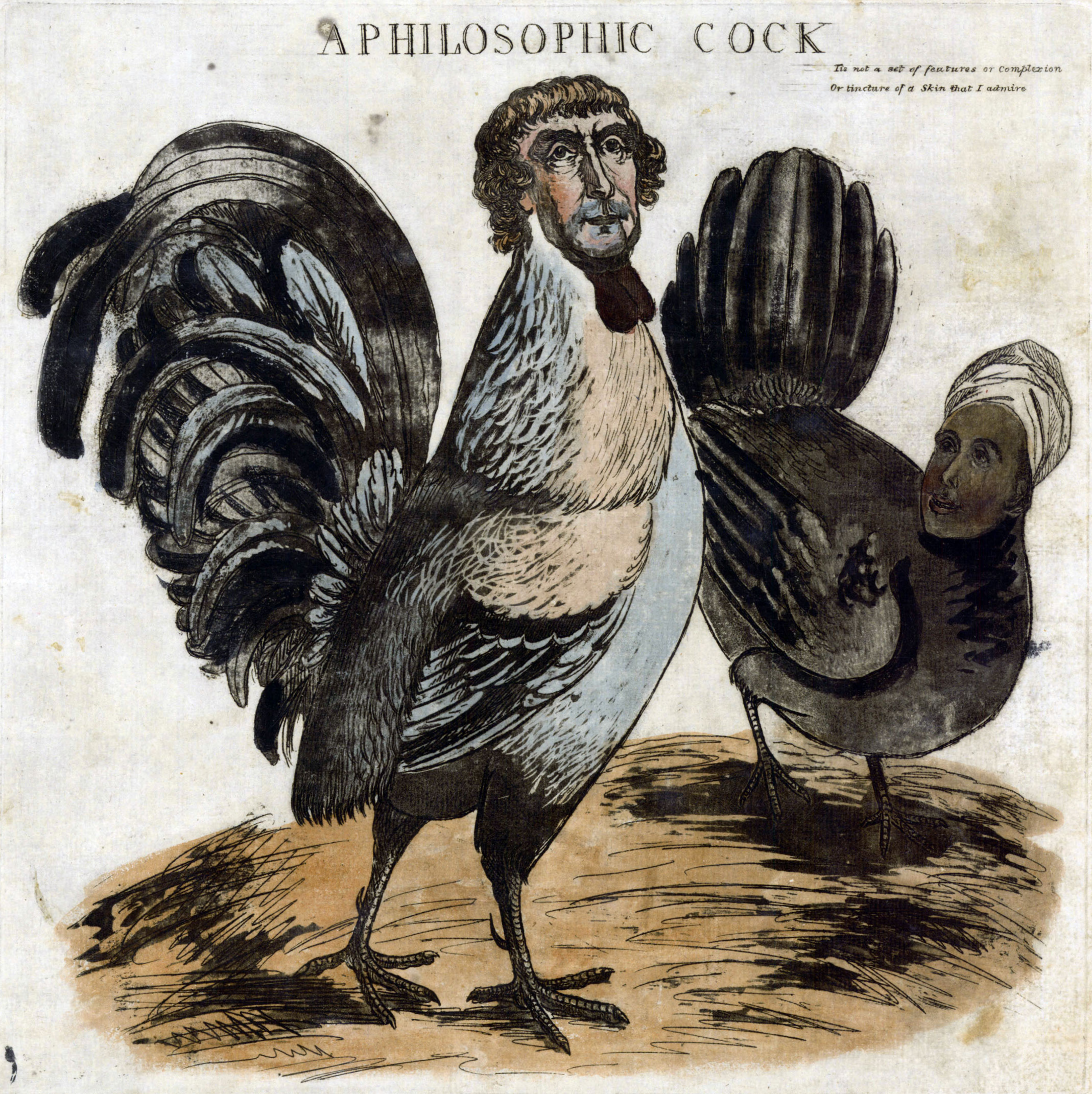
“A Philosophic Cock,” James Akin, Newburyport, Massachusetts, c.1804. Hand-colored aquatint. Courtesy of the American AntiquarianSociety, Worcester, Massachusetts (https://encyclopediavirginia.org/a-philosophic-cock/)
And it wasn’t just the newspapers. Others, too, jumped on the bandwagon.
In colonial times, people hung maps, newspapers, and satirical prints in taverns such as the Green Dragon, where, with drinks in hand, the Sons of Liberty and others gathered to debate politics. You could buy these printed materials for a few shillings and take them home to fuel debates and mock opponents. They were basically the memes of the time.
It was in that world that engraver James Akin, around 1804, created a hand-colored aquatint titled “A Philosophic Cock.” It depicts Jefferson as a strutting rooster courting a black hen, meant to be Sally Hemings. (5) The image mocked the whole rumor in a way that stuck. Jefferson never responded to any of these accusations. Basically, he wouldn’t dignify such statements with a response. In a letter to James Monroe, he said, “It has been so impossible to contradict all their lies that I have determined to contradict none; for while I should be engaged with one, they would publish twenty new ones.” (6)
Jefferson figured answering would just give the stories more life and drag him down to Callender’s level. So what happens next? Callender followed up with a series of editorials mocking Jefferson’s silence. He taunted Jefferson, accusing him of cowardice and hypocrisy.
But these accusations had little effect on the general public, and political reaction at the time was relatively muted. It didn’t escalate into a major crisis. In fact, many supporters dismissed the story outright. Even Jefferson’s political rivals at the time, John Adams and Alexander Hamilton, rejected Callender’s charges because they knew Jefferson’s character. And, as I mentioned earlier, they had their own personal experiences with Callender’s lies.
As for Callender, his life did not go well: drinking, fights, and an altercation with a former lawyer. He even had a falling out with his newspaper partner. In July 1803, he was found dead by the James River, drunk. Some said accident, others suicide, or worse. Either way, he was gone. (7) We’ve seen that early on, print started the fire, but also kept it contained within partisan circles. Democratic-Republican papers brushed off the accusations, so the story faded and didn’t hurt Jefferson’s 1804 reelection. For a while, it mostly disappeared from public discourse.
Four Score and Seven Years Ago…
By the mid-1800s, Jefferson and his “all men are created equal” line received renewed attention as the country debated slavery—the Compromise of 1850, the Fugitive Slave Act, the Dred Scott decision, and the Lincoln-Douglas debates. Republicans used the Declaration to push against slavery; Democrats pointed to Jefferson’s own slaveholding and states’ rights views. The country was on the verge of civil war, and magazines like Harper’s Weekly and Putnam’s Monthly were front and center of the discussion.
It was in that climate that two very different accounts emerged regarding Jefferson’s private life and the Hemings rumor.
One was from Isaac Granger Jefferson, a former slave who worked as a blacksmith at Monticello. In 1847, as a free man in Petersburg, Virginia, he told his story to Reverend Charles Campbell. The dictated memoir provides a rare glimpse into plantation life. Isaac called Randolph Jefferson, Thomas Jefferson’s younger brother, a “mighty simple man” who hung out with the enslaved people. He said that Randolph “used to come out among black people, play the fiddle and dance half the night,” portraying him as sociable and comfortable among the enslaved people during his visits to Monticello. (8)
Some modern researchers point to Randolph Jefferson as possibly being the father of Edwin Jefferson, a son born to Betty Brown Hemings, Sally Hemings’s half-sister and a longtime domestic servant at Monticello. In her 2014 book From Whence We Came, M. Marilynn Jefferson makes this case using family oral traditions, DNA evidence, and genealogical records. She presents herself as a direct descendant of that line, using her work to draw Randolph into the broader discussion of Hemings-Jefferson family ties. (9)
In 1858, Henry S. Randall’s three-volume biography of Jefferson, The Life of Thomas Jefferson, drew on letters, writings, family papers, and conversations with Jefferson’s grandson, Thomas Jefferson Randolph. During a visit to Monticello, Randolph told Randall, “there was not the shadow of suspicion that Mr. Jefferson in this or any other instance ever had commerce with his female slaves.” He said he ran the place day-to-day, lived close enough to notice anything unusual, and saw nothing out of the ordinary, nor any unusual closeness with Sally or anyone else.
Randolph also pointed the finger at Jefferson’s nephews, Peter and Samuel Carr, as the likely fathers of Sally’s children. (10) That explanation got passed along privately but showed up in later publications.
In 1871, Sarah N. Randolph, Jefferson’s great-granddaughter and Thomas Jefferson Randolph’s daughter, published The Domestic Life of Thomas Jefferson. Using family letters and memories, she painted a warm picture of Jefferson at home: with his kids and grandkids, the everyday Monticello moments. It felt personal and gave an insider look at the family.
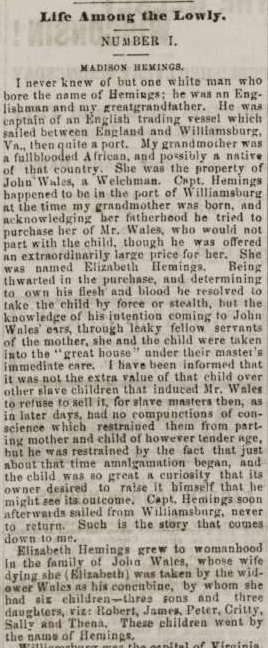
“Life Among the Lowly, No. 1,” https://encyclopediavirginia.org/primary-documents/life-among-the-lowly-no-1-by-madison-hemings-march-13-1873/)
This work targeted a dedicated and influential audience, those individuals interested in Jefferson’s private life rather than his public achievements. The book remains influential today. It has been reprinted in modern editions, and biographers often draw anecdotes and details directly from it. The book has become the primary source for the “official” family view of Jefferson’s domestic life.
By contrast, in 1873, Madison Hemings, the son of Sally Hemings, gave a very different account in an interview published in the Pike County Republican, an Ohio newspaper. Titled “Life Among the Lowly, No. 1,” his story provided a firsthand perspective from someone who had been enslaved at Monticello. He described how his mother, Sally, accompanied Jefferson to Paris in the late 1780s, became pregnant there, and made an informal “treaty” with Jefferson: if she returned to Virginia with him, her children would eventually be freed and granted certain privileges. Madison also stated plainly that Thomas Jefferson was his father and that he had fathered several children with Sally, whom he called his “concubine.” (11)
This published article directly supported the old rumor. But for a long time, most historians and the public ignored it, trusting the denials from Jefferson’s family more and seeing enslaved people’s words as less reliable.
DNA and the Journal Nature
Into the 20th century, print kept the story going strong. Biographies and history books stuck with the family line, usually dismissing the Hemings claims as old smears concocted by a shady character like Callender.
Then, on November 5, 1998, the scientific journal Nature published a DNA study that flipped the whole debate. The headline was blunt: “Jefferson fathered slave’s last child.” It showed a clear genetic link between a Jefferson male line and Eston Hemings, Sally’s youngest son, and it ruled out the Carr nephews as possible fathers. (12) Between the article and the media storm that followed, many people quickly accepted that Thomas Jefferson was the father.
Jefferson fathered slave’s last childNature, November 5, 1998 (https://www.nature.com/articles/23835)
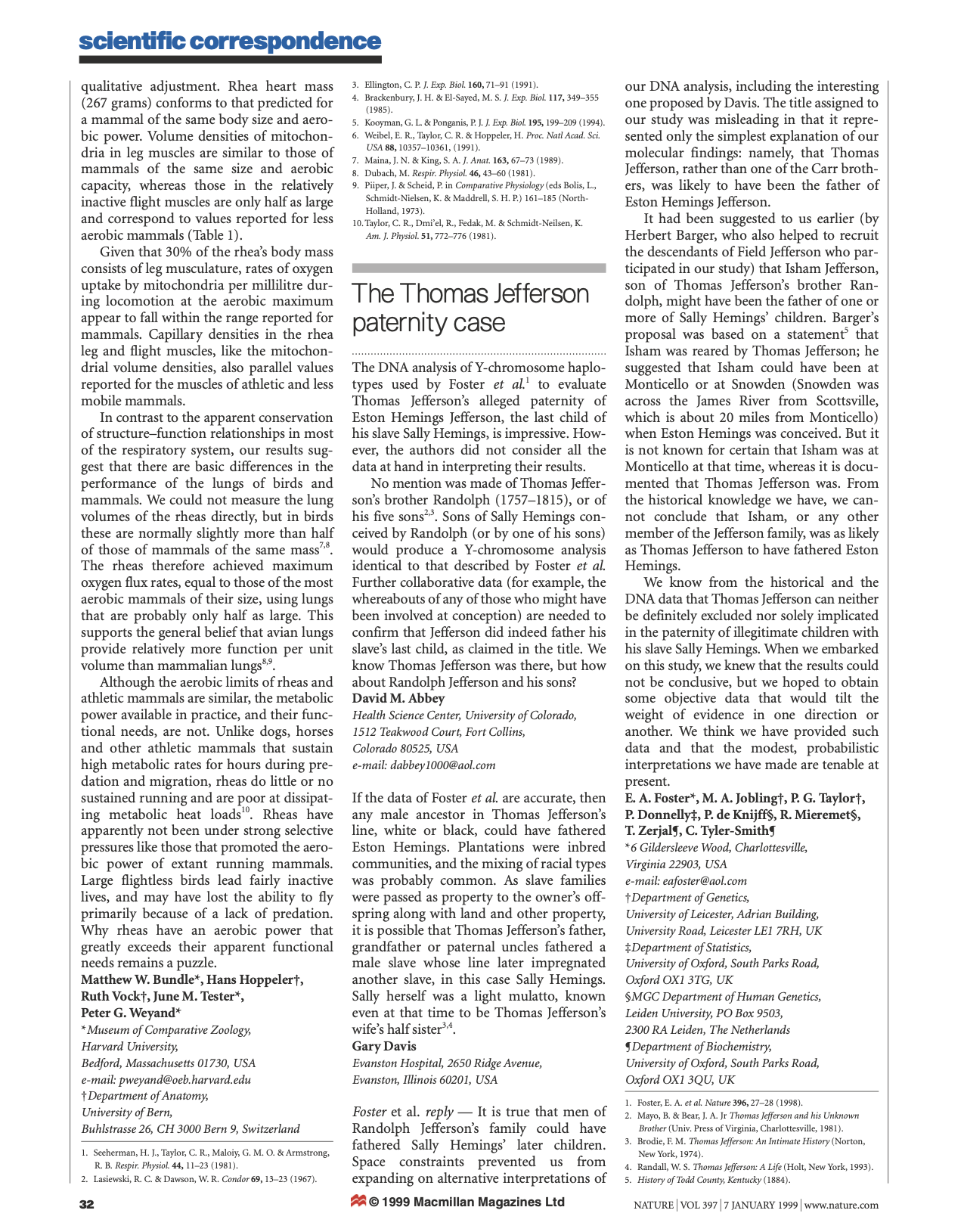
A couple of months later, in January 1999, Nature ran a correction. The authors of the study, including the lead author, Eugene Foster, admitted, “The title assigned to our study was misleading in that it represented only the simplest explanation of our molecular findings…” They continued, “We know from the historical and the DNA data that Thomas Jefferson can neither be definitely excluded nor solely implicated in the paternity of illegitimate children with his slave Sally Hemings.” So, the science only proved that “a” man from the Jefferson family line fathered Eston Hemings. It did not prove Thomas Jefferson himself was the father, and it didn’t rule out other relatives, such as Randolph Jefferson. In other words, the science narrowed the field but didn’t deliver a final answer. (13)
The Nature piece prompted groups such as the Thomas Jefferson Foundation to state in its 2000 report that there was a “high probability” that Jefferson was the father. While the Thomas Jefferson Heritage Society, “after reviewing essentially the same material, reached different conclusions, namely that Sally Hemings was only a minor figure in Thomas Jefferson’s life and that it is very unlikely he fathered any of her children.” (14)
Today, print, in books, articles, and even digital formats, is providing a platform for voices that were long ignored, and it’s pushing back against old prejudices that were once taken for granted. Annette Gordon-Reed’s 2008 book The Hemingses of Monticello (15) examines how earlier recorded histories often ignored or dismissed what enslaved people said about their own lives. Newspapers, such as The New York Times, publish articles on the subject. Others, such as the Thomas Jefferson Heritage Society, and genealogists and historical researchers, like Cynthia H. Burton, publish reports and books favoring alternatives, thereby maintaining debate.
We can see from this examination of the Jefferson-Hemings debate that print doesn’t just record history; it actively shapes it. It helps decide what we remember and believe. From Callender’s scandal sheets to personal memoirs to modern scientific studies, it has taken us from wild gossip to a more nuanced historical account. It can spread rumors, protect reputations, silence certain voices, or finally let them be heard. And it reminds us that how we understand the past often depends on who had access to the printing press and who did not.
Sources:
1. Biography: James Callender https://www.pbs.org/wgbh/americanexperience/features/adams-james-callender/
2. James Thomson Callender (1757 or 1758–1803) https://encyclopediavirginia.org/entries/callender-james-thomson-1757-or-1758-1803/
3. Primary Sources (see Appendix E) https://monticello-www.s3.amazonaws.com/files/old/inline-pdfs/jefferson-hemings_report.pdf#page=20
4. Biography: James Callender https://www.pbs.org/wgbh/americanexperience/features/adams-james-callender/
5. Political attack ads in the era of the founding fathers https://loc.gov/exhibits/jefferson/jefffed.html#140
6. Biography: James Callender https://www.pbs.org/wgbh/americanexperience/features/adams-james-callender/
7. “Life of Isaac Jefferson of Petersburg, Virginia, Blacksmith” by Isaac Jefferson (1847) https://encyclopediavirginia.org/primary-documents/life-of-isaac-jefferson-of-petersburg-virginia-blacksmith-by-isaacjefferson-1847/
8. From Whence We Came Paperback https://www.amazon.com/Whence-We-Came-Marilynn-Jefferson/dp/1496906608
9. Letter from Henry S. Randall to James Parton (June 1, 1868) https://encyclopediavirginia.org/primary-documents/letter-from-henry-s-randall-to-james-parton-june-1-1868/
10. Recollections of Madison Hemings https://www.monticello.org/encyclopedia/recollections-of-madison-hemings-1873
11. Hemings, M. (2022, July 28). “Life Among the Lowly, No. 1” by Madison Hemings (March 13, 1873) - Encyclopedia Virginia. Encyclopedia Virginia. https://encyclopediavirginia.org/primary-documents/life-among-the-lowly-no-1-by-madison-hemings-march- 13-1873/
12. Jefferson fathered slave's last child. Nature 396, 27–28 (1998) https://www.nature.com/articles/23835
13. Reply: The Thomas Jefferson paternity case. Nature 397, 32 (1999) https://www.nature.com/articles/16181
14. Thomas Jefferson and Sally Hemings: A Brief Account https://www.monticello.org/slavery/jefferson-and-sally-hemings/a-brief-account
15. The Hemingses of Monticello: An American Family, Paperback https://www.amazon.com/Hemingses-Monticello-American-Family/dp/0393337766