Five Things You Never Knew About the Declaration of Independence: The Case for Revolution
/The Declaration of Independence isn’t just some grand statement; it was born out of real frustration. Many of the key players, like Benjamin Franklin and John Hancock, started out as reluctant revolutionaries. They hoped for peace with England, but a series of harsh actions by King George III pushed them over the edge. The Declaration lists 27 specific grievances, essentially a laundry list of complaints ranging from unfair taxes to military overreach. What’s fascinating is how many of these stemmed from events involving printers and the press, since printing was the main way of spreading ideas back then. Printers weren’t just bystanders; they were often right in the crosshairs, and their stories highlight why the colonists finally said “enough.”
The Stamp Act: Taxing the Press into Rebellion
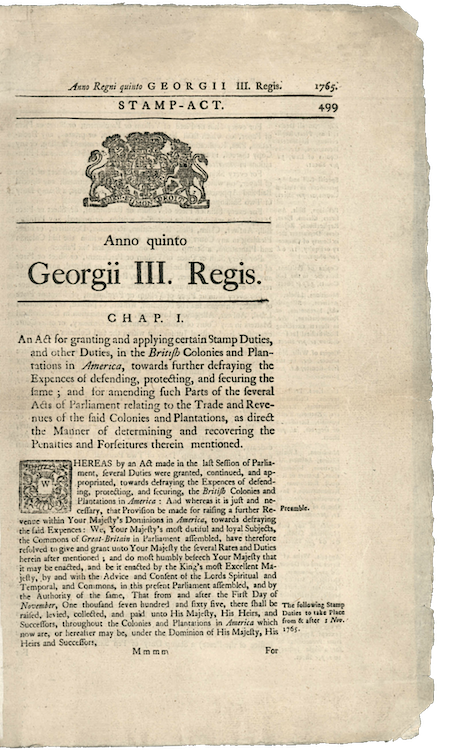
Our story begins on November 1, 1765, the date the Stamp Act went into effect in the colonies. What, exactly, was the Stamp Act? We can read it directly from the Stamp Act pamphlet, printed by the Loyalist printing house of Richard and Samuel Draper, and Green and Russell, just as our colonial forefathers did.(1) At the top, it starts with Latin: ‘Anno quinto Georgi III. Regis. Chap. I.’ which translates to, ‘In the fifth year of King George III’s reign, Chapter 1.’ This is the formal way every British law began back then, but to the colonists, seeing those words on paper must have felt like the king personally reaching across the ocean to tax them.
It reads:
”An Act for granting and applying certain Stamp Duties, and other Duties, in the British Colonies and Plantations in America, towards further defraying the Expenses of defending, protecting, and securing the same; and for amending such Parts of the several Acts of Parliament relating to the Trade and Revenues of the said Colonies and Plantations, as direct the Manner of determining and recovering the Penaities and Forfeitures therein mentioned.”
So, the British were trying to recoup some of the money they had spent during the French and Indian War, and to do that, they planned to impose “certain Stamp Duties,” basically taxes on the colonists. And what were they going to tax? Let’s read on.
“For every Skin or Piece of Vellum or Parchment, or Sheet or Piece of Paper, on which shall be engrossed, written, or printed, any Declaration, Plea, Replication, Rejoinder, Demurrer, or other Pleading, or any Copy thereof, in any court of Law within the British Colonies and Plantations in America, a Stamp Duty of Three Pence.”
As we read on, there’s a Stamp Duty of Two Shillings on Bail documents in court. On a Certificate of any Degree taken in any University, there was a duty of two pounds; and it goes on and on, including newspapers, playing cards, basically anything having to do with paper.
We all know how taxes can rile people up. That’s exactly what this Act did. It was a direct hit not just on printers but on anyone who used paper. And, the main problem was that this tax was passed without any representation from the colonists.
The Stamps
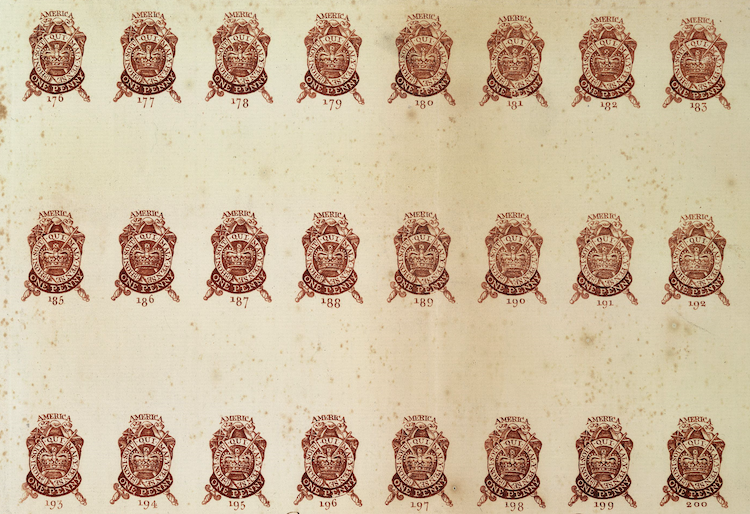
The stamps themselves are interesting. The image below is a proof sheet of a one-penny Stamp printed in dark red ink on thick laid paper.(2) These are not the stamps; these are just proofs of the die used to emboss the stamp into the paper. This proof sheet was made in London to check the design before they began embossing the paper sheets.
If you look closely, you can see the royal symbols: St. Edward’s Crown inside the Order of the Garter, a mantle, a scepter, and a sword. At the top, it says ‘AMERICA,’ at the bottom ‘ONE PENNY,’ and then there’s a number. That’s the die number. The Board of Stamps made 200 copper dies, that’s the number you see under each impression of each die. You can also see them on the larger proof sheet.
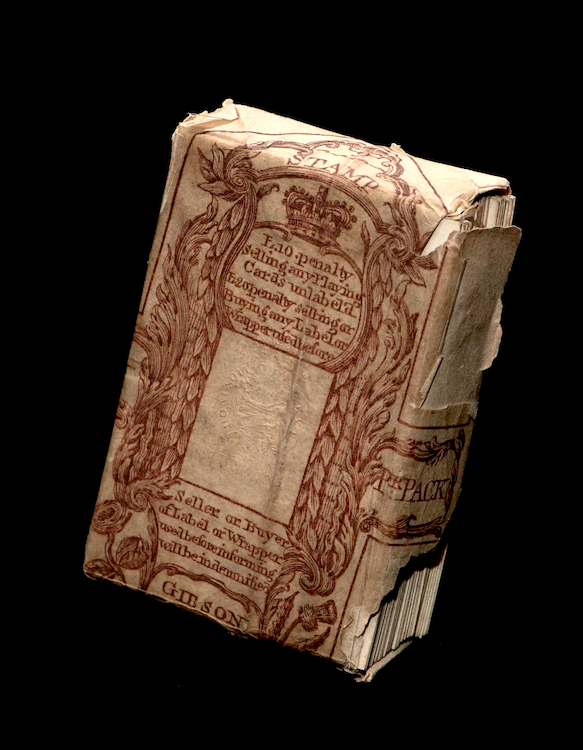
Now, in the image, you see what the actual tax stamp looked like on everyday items, like this deck of playing cards. Notice there’s no red ink. That’s because the stamp was embossed, pressed directly into the paper with a heavy copper die. It’s a raised, colorless impression, what we in the printing industry call ‘blind embossing.’ If you were to run your finger over it in real life, you’d feel the texture.(3)
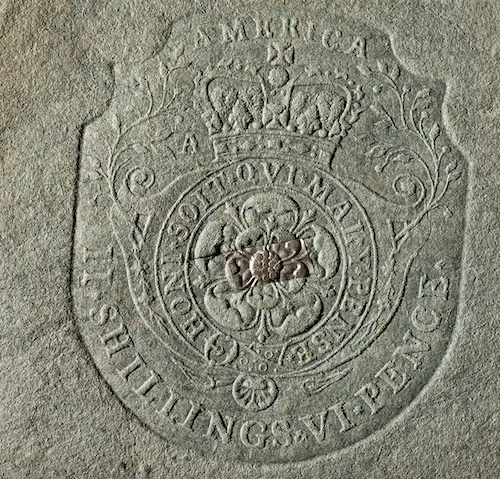
And for important documents written on vellum or parchment, like deeds or contracts, where you couldn’t emboss directly into the material, they used a different method. (4) The revenue stamp was embossed on separate paper, usually beige or dark blue, like this one seen here, which was then glued and stapled directly onto the vellum. If you look closely at the image, you can see the metal staple. To stop anyone from peeling it off and reusing the stamp, they covered the back of the staple with a small cipher bearing the Coat of Arms of George III. You can see that in the second image below. Again, no ink on the stamp itself—just that subtle raised impression proving the tax had been paid.
So when printers bought paper for newspapers, pamphlets, deeds, or even playing cards, they weren’t just buying sheets; they were buying government-controlled, pre-taxed paper. That direct, physical intrusion into everyday life is one of the things that fueled so much anger among the colonialists and led the writers of the Declaration of Independence to include in the list of grievances against King George, that he was: “…imposing Taxes on us without our Consent.” Basically, no taxation without representation.
Benjamin Franklin and the Stamp Act
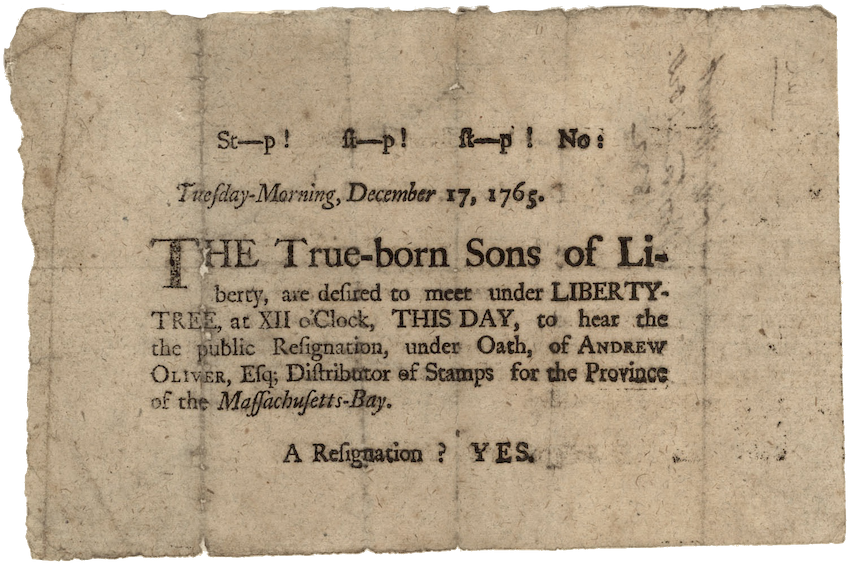
Franklin was in England when the Stamp Act passed, and at first, he didn’t see much wrong with it. He figured it was a reasonable way to help pay for the colonial defense after the French and Indian War.(5) But then the angry letters started rolling in from back home, describing how many people boycotted stamped paper and printed defiant articles. To mourn the “death” of a free press, newspapers ran editions with thick black borders, symbolizing grief and resistance and serving as a visual protest that spread the message far and wide. In Boston and New York, printers teamed up with groups like the Sons of Liberty to spread anti-Stamp Act messages. Protests erupted, with effigies of tax collectors, as that of Andrew Oliver was hanged in the streets. Printers helped amplify the fury through pamphlets and broadsides. Historians note that this unified the colonies’ printers, turning them into key voices for resistance.
For Franklin, those letters from back home changed everything. By February 13, 1766, Franklin was in front of the British House of Commons for a marathon four-hour grilling. During that time, 174 questions were fired at him from members of Parliament who wanted to understand, or maybe just poke holes in, the colonial uproar. He answered calmly and sharply, explaining that the colonies already paid heavy local taxes, that there wasn’t enough hard currency circulating in America to cover the stamp duties for even a single year, and that forcing the act would backfire badly. One of his most quoted lines came when he warned that, if the British sent troops to enforce the Stamp Act, the troops wouldn’t find a rebellion—they might well create one.(6)
Franklin’s testimony, printed as the pamphlet Examination before the Committee of the Whole of the House of Commons, was soon widely circulated in both Britain and the colonies, helping tip the scales. Parliament repealed the Stamp Act just over a month later. For printers, it was a huge win: the tax that had threatened to kill their businesses was gone, and Franklin’s performance showed how one well-prepared voice could sway policy and keep the press free to stir the pot.
The Townshend Acts
Victory over the Stamp Act repeal was short-lived. In response to the backlash against that act, the British imposed the Townshend Acts, which placed taxes on imports such as paper, glass, and tea. For printers, again, this meant higher costs for the raw materials they needed to produce newspapers and pamphlets. And, again, this was enacted without any representation from the colonists. Just another event to reinforce why the 17th grievance was included in the Declaration.
In response to this sneaky and oppressive act, printers fought back by publishing essays like those from John Dickinson, a Pennsylvania lawyer and farmer who penned “Letters from a Farmer in Pennsylvania.”(7) These letters argued against taxation without representation and were reprinted across the colonies, unifying colonial opposition. Women also became deeply involved, forming groups like the Daughters of Liberty to lead boycotts of British goods. They organized spinning bees to make homespun cloth to replace imported fabrics and signed pledges to avoid taxed items, thus showing how the acts drew in everyday folks beyond just merchants. In places like Philadelphia, boycotts hit British goods hard, and printers used their presses to organize resistance. This act deepened the divide, as it showed Britain wasn’t backing down after repealing the Stamp Act. These actions by the British pushed more moderate folks toward revolution.
John Hancock’s Wine Smuggling Fiasco
Everyone has heard of the Boston Tea Party, but it was actually wine that turned John Hancock into a full-on revolutionary. Hancock, like Franklin, was a reluctant patriot. At first, he was all for keeping the peace with Britain. It was great for his business, as he was one of Boston’s richest merchants. He made a fortune importing wine and other goods on his ship, the Liberty. But in 1768, British customs officials accused his crew of underreporting the cargo to dodge import duties. They seized the ship right in the harbor, which set off huge riots across Boston as people saw it as another example of heavy-handed British overreach.(8) This event, again, emphasizes the grievance regarding “imposing Taxes on us without our Consent.” And the outrage led to more British troops flooding into Boston, prompting the 14th grievance in the Declaration, in which the author charged King George with “…quartering large bodies of armed troops among us.” Those soldiers set the stage for the Boston Massacre two years later, where tensions boiled over into bloodshed.
The accusation of tax avoidance led to Hancock facing charges without a jury trial. Now, another grievance, the 18th in the list, which accused King George of “…depriving us, in many cases, of the benefits of Trial by Jury,” comes into play.
Hancock got off, thanks to public support, but the ordeal caused him to align with radicals like Samuel Adams, and he started bankrolling Patriot groups like the Sons of Liberty.(9)
The Boston Massacre and Paul Revere’s Engraving
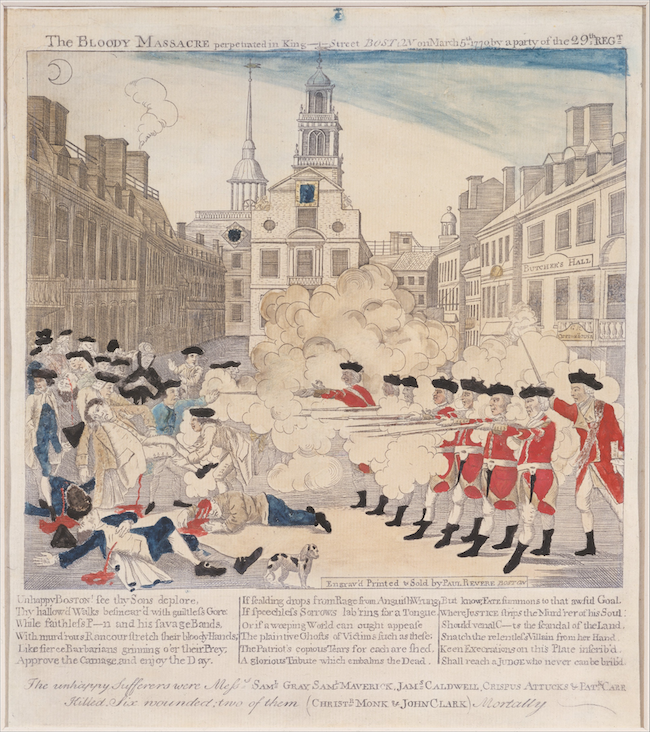
Hancock’s ordeal caused the British to ramp up their military presence, and things exploded with the Boston Massacre, where British soldiers fired on a crowd, killing five colonists. But what really amplified it was the printing press. Paul Revere, a silversmith and engraver (engraving being a key part of the printing industry back then), rushed out a dramatic engraving called “The Bloody Massacre,” showing soldiers gunning down innocent people.(10, 11) It was pure propaganda, exaggerated for effect, and copies spread like wildfire across the colonies. Printers reprinted Revere’s image in newspapers, along with broadsides, pamphlets, and other materials detailing the event, like eyewitness accounts in the Boston Gazette. These printers didn’t just report the news; they created tools to rally support, showing how print could turn a local tragedy into a colonial cause. These graphic visuals highlighted several grievances listed in the Declaration, including the 14th, about quartering troops, and the 18th, about the lack of fair trials, as soldiers received light sentences from Crown-appointed judges.
The Boston Tea Party and the Role of Benjamin Edes
The Tea Act of 1773 wasn’t a brand-new tax, but it kept an old duty in place and gave the British East India Company a monopoly on tea sales, which felt like more taxation without consent. Protests had been building for weeks, with the Boston Gazette, run by Benjamin Edes and John Gill, publishing sharp critiques that kept the pressure on. On December 16, after failed negotiations, a core group of the Sons of Liberty met at Edes’s house on Brattle Street to finalize their protest plans. Later that evening, Edes and his guests made their way to his print shop on Queen Street. They then moved to the upstairs office to disguise themselves as Mohawk Indians by painting their faces, donning blankets, and wearing ragged outfits to conceal their identities while making a bold symbolic statement about American independence.(12) Edes, a member of the Loyal Nine, the directing group behind the Sons of Liberty, was central to this; his newspaper had helped finance and publicize the resistance.(13) The disguised men joined other protesters at Griffin’s Wharf, boarded the three ships carrying the tea, and dumped 342 chests, 46 tons, of tea into the harbor. This direct action prompted the Intolerable Acts, which shut down Boston’s port and hardened attitudes toward revolution. Printers like Edes and Gills weren’t just observers; they were active organizers, using their presses, shops, and homes to make it happen. This was demonstrated two years later, in 1775, when the British imprisoned Gill, accusing him of “printing Treason, Sedition, and Rebellion.”
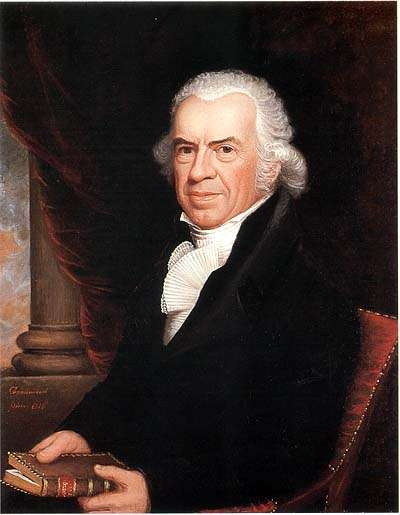
Isaiah Thomas’s Daring Press Smuggling—and Beyond
Isaiah Thomas wasn’t born into privilege like Franklin or Hancock; he came from genuine hardship. His father abandoned the family to chase fortune in the South sometime after Isaiah’s birth, then died in North Carolina around 1752, when Isaiah was only three. That left his mother struggling to support five young children on almost nothing. In colonial Boston, families in such situations often turned to the city’s Overseers of the Poor, a group of local officials who supervised public relief for the destitute. They provided basic aid, such as food, but focused heavily on preventing long-term dependency. For children without support, they arranged apprenticeships that legally bound them to a master to learn a trade, receive room and board, and eventually become self-sufficient. This was the era’s version of welfare: pragmatic, mandatory, and sometimes harsh, as it frequently separated kids from family.
Thomas received only six weeks of schooling before the Boston Overseers arranged an apprenticeship with printer Zechariah Fowle.(14) He was only six years old, much younger than the typical 13- to 14-year-olds who became apprentices. For families in deep poverty, like Thomas’s, the Overseers often placed children in apprenticeships at a younger age to relieve the town of the financial burden immediately.
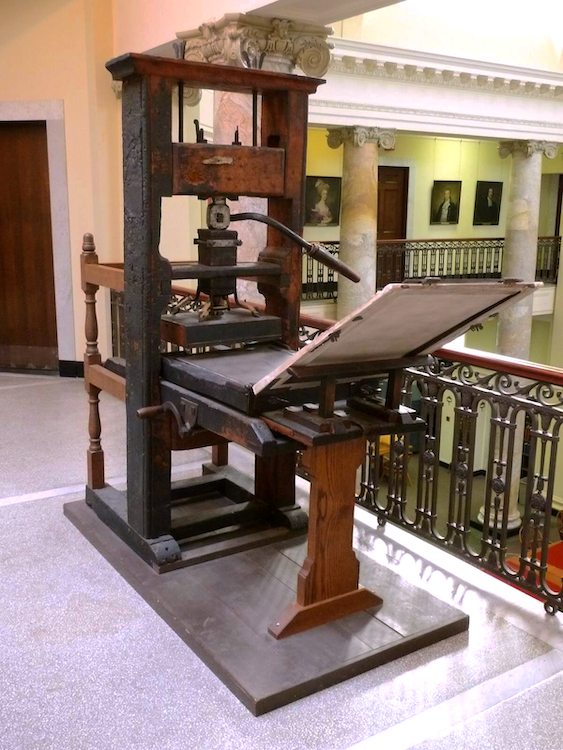
Fowle put him to work setting type. His first typesetting job was a popular ballad called The Lawer’s Pedigree.(15) At six years old, he was too small to reach the typecases, so he stood on an 18-inch bench.(16) Thomas wrote, “I set the types, which were double Pica, for this ballad in two days, tho’ I then knew only the letters, but had never been taught to put them together and spell.”(17) Thomas later recalled that Fowle skimped on teaching him the basics, leaving him to figure much of it out on his own.
By his teens, Thomas was already handling much of the day-to-day work in Fowle's print shop, so when the Stamp Act protests began in 1765, sixteen-year-old Thomas fully understood what that meant for the business: every newspaper, pamphlet, and sheet of paper now carried a tax that could have a devastating impact on the shop. That personal stake drove him to join the demonstrations. He was there at the hanging of a stamp-master effigy at the Liberty Tree.(18) Shortly after, the authorities questioned him about the others involved. He flat-out refused to name names. They threatened him with jail time. This action by the authorities illustrates the reason behind the 18th grievance in the declaration, which accused the king of “depriving us, in many cases, of the benefits of Trial by Jury.”
Thomas was a feisty, rebellious teenager, bold enough to stand up to authorities, and that same independent spirit soon led him to break his indenture with Fowle and run away. He headed first to Halifax, Nova Scotia, where he took over much of the Halifax Gazette and turned it into a protest against the Stamp Act: printing tax stamps upside down, adding devil-with-pitchfork woodcuts mocking the royal emblem, and eventually ditching the stamps altogether. His antics got him fired, but they showed he wasn’t backing down.(19) From there, he wandered as a journeyman printer through Portsmouth, Charleston, and other cities, honing his printing skills before returning to Boston in 1770, where he patched things up with Fowle. The two printers formed a partnership and launched The Massachusetts Spy.(20) Later that year, Thomas bought out Fowle’s share, making him the sole owner. The purchase of the business included the 1747 London-made press he had learned on as a child. He later nicknamed it “Old Number One.” It is on exhibit today at the American Antiquarian Society.(21)
Thomas aimed his newspaper at working people, a group he was very familiar with. The paper’s motto was “Open to all parties, but influenced by none.” In his paper, he sharply criticized the British for their taxes and other grievances that would eventually be included in the Declaration.
Thomas’s paper also resurrected a political cartoon that Benjamin Franklin once used at the beginning of the French and Indian War. Franklin’s “JOIN, or DIE” cartoon, originally printed in the Pennsylvania Gazette, 1754, depicts a rattlesnake separated into pieces. The cartoon warned the colonists that if they didn’t unify, they would not survive. Thomas revived and reimagined it for the Revolution, integrating it into the masthead of The Massachusetts Spy, with Paul Revere engraving the fiercer, updated design.(22)
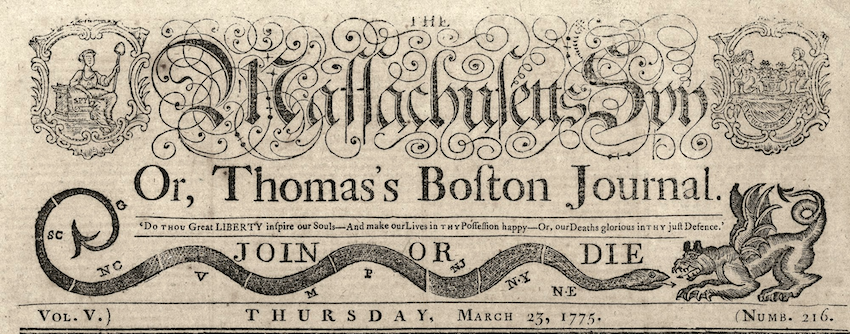
It’s no surprise that Thomas’s print shop doubled as a meeting place for the Sons of Liberty, which is why the British called it a “sedition foundry.” That made it an obvious target for seizure. John Hancock, his ally in the Sons of Liberty, warned him that the press could be seized and advised relocating it from Boston to a safer inland location. On April 16, 1775, just days before the ride of Paul Revere and the battles at Lexington and Concord, Thomas, with the help of his firends, disassembled his printing press, grabbed his cases of type, and, under the cover of darkness, rowed his equipment across the Charles River, and then, with help from another Sons of Liberty member, Timothy Bigelow, hauled it 40 miles to Worcester. The press was then reassembled in Bigelow’s basement.(23)
As a side point, it’s important to recognize that Thomas’s decision to move his press from Boston to Worcester, driven by the growing British military threat, foreshadowed the very real perils that awaited many signers of the Declaration in the months and years to come. While Thomas acted to protect his printing operation before independence was formally declared, many signers, who we will discuss in our next blog post, faced imprisonment, property loss, and constant danger precisely because they had openly pledged their lives and fortunes to the cause.
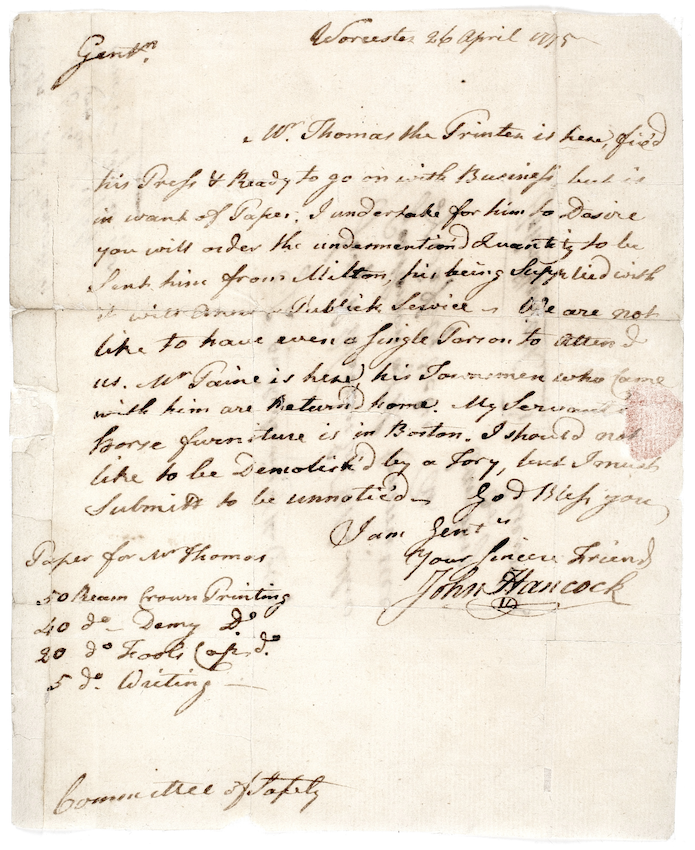
When Thomas left Boston, he wasn’t able to bring any paper with him during the hurried nighttime escape, so Hancock stepped in and wrote to the Provincial Congress to secure some paper. British trade restrictions, like those behind the 16th grievance listed in the Declaration: “For cutting off our Trade with all parts of the world,” choked imports; thus, getting supplies inland took time.
A few days later, on April 19, Thomas, Hancock, and other Sons of Liberty figures like Sam Adams were there at Lexington and Concord, and witnessed “The shot heard 'round the world,” which initiated the American Revolutionary War.
Within the next two weeks, the paper arrived, the type was set, the press was rolling, and Thomas printed his eyewitness account of the battles. And, on May 3, The Massachusetts Spy carried the news. Turning to page three, readers saw, ”AMERICANS! Forever bear in mind the BATTLE of LEXINGTON! where British Troops... wantonly... fired upon and killed a number of our countrymen, then robbed them of their provisions, ransacked, plundered and burnt their houses!”(24) These words amplified the 14th and 15th grievances, quartering armed troops among us, and shielding troops from real punishment.
The Massachusetts Spy continued to regularly print news, updates, and commentary on major developments, underscoring its role as a vital line of communication during the war.
In fact, here’s an interesting news story. In our previous blog post, number two, on the Printed Copy of the Declaration of Independence, we discussed how, once printed, it was sent all through the colonies and read in taverns, churches, town greens, or anywhere else people could gather. Well, on July 22, 1776, Isaiah Thomas stood on the steps of the Old South Church in Worcester and read the Declaration of Independence aloud to a crowd that had gathered from miles around; it was the first public reading of the document in Massachusetts. People cheered, bells rang, and the celebration spilled into a tavern afterward, where toasts were drunk to mark the moment. And, of course, two days later, his own paper reported the entire event.
According to the paper, as people were drinking, they took turns toasting the event. The paper lists 24 toasts from that night. Most are what you’d expect.
“Prosperity and perpetuity to the United States of America.”
But then you get this one that really stuck out; number 14. “Perpetual itching without the benefit of scratching to the Enemies of America.” You can almost hear the laughter, the clinking of the glasses, the pride, the happiness of becoming America.(25)
Isaiah Thomas’s story, like those of so many other printers, shows exactly why the Declaration spelled out that list of grievances in plain language.
Benjamin Franklin’s Print Shop Ravaged
When the British occupied Philadelphia in 1777–78, troops were quartered near the city’s printing shops, including those tied to Franklin’s old Market Street operation, which was run by his grandson and partners. Soldiers damaged presses, scattered type, melted lead for bullets, and looted or burned paper stocks, leaving a lot of the equipment inoperable. Franklin noted the widespread injury in letters, and a 1778 report from the Continental Congress even mentioned Philadelphia print shops as sources of seized materials.(26) This disruption hit the Pennsylvania Gazette and the local trade hard, exemplifying the complaint of quartering “large bodies of armed troops among us” and the broader pattern of property destruction that turned reluctant figures like Franklin into committed revolutionaries. Personal losses like these reveal the everyday realities that underpinned the Declaration’s list of grievances.
These stories, from tax revolts to midnight smuggling, paint a picture of why the colonists listed those 27 grievances. Printers like Franklin and Thomas weren’t just reporting the news; they were making it, often at great personal cost. It all culminates in the Declaration’s powerful closing: “And for the support of this Declaration, with a firm reliance on the protection of divine Providence, we mutually pledge to each other our Lives, our Fortunes and our sacred Honor.” These guys lived that pledge, risking everything to print the truth and rally the cause. Next time you read the Declaration, remember it wasn’t hypothetical, it was forged in these gritty, real-world clashes.
Footnotes
1. MHS Collections online: [Stamp Act (1765)]. (n.d.). https://www.masshist.org/database/viewer.php?item_id=219&mode=large&img_step=1&pid=2#page1
2. 1p Stamp Act of 1765 proof | Smithsonian Institution. (n.d.). https://www.si.edu/object/1p-stamp-act-1765-proof%3Anpm_0.022044.1
3. The Stamp Act. (n.d.). https://www.colonialwilliamsburg.org/discover/resource-hub/timelines/stamp-act/
4. Stamp from the Stamp Act of 1765. (n.d.). Smithsonian Learning Lab. https://learninglab.si.edu/resources/view/61127#more-info
5. Benjamin Franklin’s notes about the Stamp Act. (n.d.). The New York Public Library. https://www.nypl.org/events/exhibitions/galleries/beginnings/item/3562
6. University of Virginia Press, “Founders Online: Examination Before the Committee of the Whole of the House Of …,” n.d., https://founders.archives.gov/documents/Franklin/01-13-02-0035
7. “MHS Collections Online: Letters From a Farmer in Pennsylvania, to the Inhabitants of the British Colonies ...,” n.d., https://www.masshist.org/database/707
8. University of Virginia Press, “Founders Online: [Seizure of Hancock’s Sloop, 1768–1769],” n.d., https://founders.archives.gov/documents/Adams/01-03-02-0016-0021
9. Neal Nusholtz, “How John Adams Won the Hancock Trial,” Journal of the American Revolution, August 30, 2016, https://allthingsliberty.com/2016/08/john-adams-won-hancock-trial/
10. HISTORY.com Editors, “The Boston Massacre | March 5, 1770 | HISTORY,” HISTORY, July 22, 2025, https://www.history.com/this-day-in-history/march-5/the-boston-massacre
11. The Boston Massacre https://www.history.com/this-day-in-history/march-5/the-boston-massacre
12. “MHS Collections Online: Edes Family Tea Party Punch Bowl,” n.d., https://www.masshist.org/database/viewer.php?item_id=1828&pid=3
13. Edward St Germain, “Loyal Nine – Explained | Founding, Actions, Legacy,” AmericanRevolution.org, n.d., https://www.americanrevolution.org/loyal-nine/
14. Isaiah Thomas indentured to apprentice with Zachariah Fowle of Boston, 4 June 1756 https://www.digitalcommonwealth.org/search/commonwealth:j6731585m
15. In pursuit of a vision: Isaiah Thomas. (n.d.). https://collections.americanantiquarian.org/inpursuit/case1/case1_1.htm
16. The diary of Isaiah Thomas. 1805-1828 : Thomas, I. [from old catalog] : Free Download, Borrow, and Streaming : Internet Archive. (1909). Internet Archive. https://archive.org/details/diaryofisaiahtho01thom/page/n15/mode/2up p.IV
17. Isaiah Thomas: Becoming a printer. (n.d.). Related Resources: The Lawyer’s Pedigree https://patriotprinter.org/becoming/resources.html
18. Hastings, P. (2025, November 19). Isaiah Thomas: Revolutionary Printer | Bibliomania. The Library of Congress. https://blogs.loc.gov/bibliomania/2025/11/19/isaiah-thomas-revolutionary-printer/
19. The Halifax Gazette, or The Weekly Advertiser · The News Media and the Making of America, 1730-1865. (n.d.). https://collections.americanantiquarian.org/earlyamericannewsmedia/items/show/101
20. A General Diffusion of Knowledge An exhibition to show volumes from the Rare Book Collection of the Thayer Memorial Library, Lancaster, Massachusetts January 15-April 21, 2012 https://thayermemoriallibrary.org/wp-content/uploads/2012/02/Exhibit-Catalog_lr.pdf
21. Isaiah Thomas’s Printing Press | American Antiquarian Society. (n.d.). https://www.americanantiquarian.org/node/6989
22. Stone, D. P., & Stone, D. P. (2018, January 23). JOIN, OR DIE: Political and Religious Controversy Over Franklin’s Snake Cartoon. Journal of the American Revolution. https://allthingsliberty.com/2018/01/join-die-political-religious-controversy-franklins-snake-cartoon/#_edn3
23. Isaiah Thomas’s Printing Press | American Antiquarian Society. (n.d.). https://www.americanantiquarian.org/node/6989
24. “Worcester, May 3. Americans! forever bear in mind the Battle of Lexington!” · The News Media and the Making of America, 1730-1865. (n.d.). https://collections.americanantiquarian.org/earlyamericannewsmedia/items/show/19
25. Haveles, V. a. P. B. K. (2016, July 1). Raise a glass to freedom, independence, and perpetual itching. Past Is Present. https://pastispresent.org/2016/good-sources/raise-a-glass-to-freedom-independence-and-perpetual-itching/
26. Joseph M. Adelman, 'Patriots, Loyalists, and the Perils of Wartime Printing' (seminar paper, Library Company of Philadelphia, February 24, 2012), https://librarycompany.org/Economics/PDF%20Files/Adelman%20-%20Seminar%20ppr%202-2012.pdf