5 Things You Never Knew About the Declaration of Independence: All But Forgotten
/Imagine this: a document that shakes the world, gets read from pulpits and tavern steps, inspires soldiers to fight a king… and then… poof. It slips quietly into the background like an old newspaper tucked under a stack of bills.
That’s pretty much what happened to the Declaration of Independence after 1776. It served its purpose as a bold wartime manifesto, justifying the break from Britain and rallying support abroad. But once the Treaty of Paris ended the Revolutionary War in 1783, the document itself virtually disappeared. For the next couple of decades, it faded, almost forgotten, while the young nation tried to figure out how to actually govern itself.
In those early years, the Declaration wasn’t the sacred icon we picture today. July 4th was marked here and there, maybe a parade in Boston or a dinner in Philadelphia where they’d raise glasses to liberty, but these were scattered, local affairs. (1) Nothing like the nationwide celebrations we know now. No mandatory school recitations, no framed copies hanging in every courthouse. The original engrossed parchment, the big handwritten sheet with John Hancock’s bold signature, was treated like any other government record. It was rolled up, stuffed in chests, and carted from city to city as Congress moved. Sometimes it just sat forgotten in a corner while clerks walked past.(2)
Why the drop-off? The country had shifted into survival mode. The war was over, but the real work was just beginning. While the Declaration gathered dust, printers stayed busy with the more immediate business of nation-building.
Building a Nation
The Articles of Confederation, adopted by Congress on November 15, 1777, became the first operating manual for the new republic. To get it ratified, Congress needed to spread the text far and wide. Much like the Declaration, the Articles were first engrossed on parchment. To distribute the information, Congress contracted with printer Francis Bailey, the same printer we discussed earlier in this series, to produce the first official pamphlet copies in 1777.(3) Those pamphlets were sent to state legislatures along with urgent letters urging ratification. States then reprinted them locally, in Boston by John Gill, in Williamsburg by Alexander Purdie, and elsewhere.(4) These were more bureaucratic, simple, functional pamphlets meant for delegates, governors, and assemblies, not dramatic rallying broadsides like the Declaration in 1776. The Declaration’s soaring words felt distant as the same printing networks that had once amplified revolutionary ideals were now focused on the gritty work of trying to make a weak confederation function, or, as it turned out, exposing why it didn’t.
Then came the Constitutional Convention in 1787. Delegates hammered out a stronger national framework amid fierce debates over representation, federal power, a bill of rights, and slavery. A printer we’re familiar with helped with the process: John Dunlap and his partner David Claypoole secretly printed the first major draft on August 6, 1787.(5) This “working” document was distributed only to the delegates and featured wide margins so they could take notes and make revisions during the intense debates.
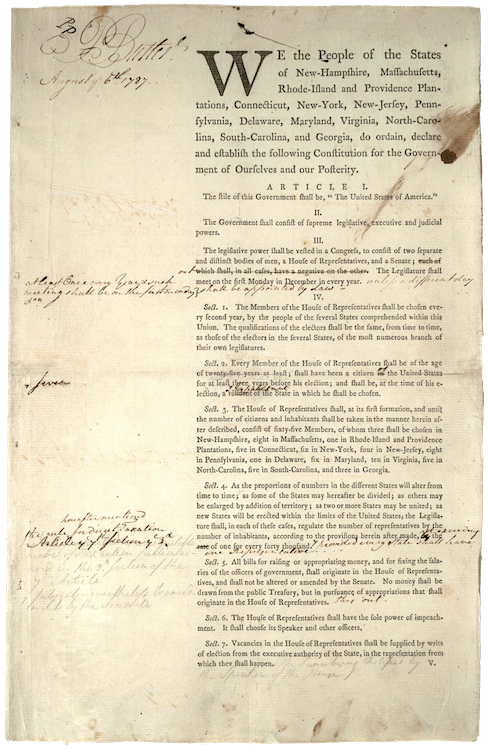
U. S. Constitution (first printing) with annotations by Elbridge Gerry https://www.masshist.org/database/viewer.php?item_id=2146&pid=17
In that early draft, the text still referred to the delegates as representatives of “the States of New-Hampshire, Massachusetts, Rhode-Island,” and so on, emphasizing a loose confederation. But by the final version, signed on September 17, the famous opening had changed to “We the People of the United States.” In just six weeks, the vision had shifted dramatically, from a mere alliance of separate states to a unified nation with a single, stronger federal government.(7)
Just like the Declaration and the Articles, the Constitution began as a formal handwritten document. After four grueling months of work, the delegates ordered a large parchment version to be engrossed by Jacob Shallus, the assistant clerk of the Pennsylvania General Assembly. He worked through the weekend of September 16 and finished the four-sheet parchment in time for the final session. On Monday, September 17, thirty-nine of the fifty-five appointed delegates signed it, adding their names under George Washington’s as president of the Convention.
That same day, to spread the proposed Constitution for ratification, the delegates turned to their official printers, Dunlap and Claypoole, and ordered 500 copies of the final text. These included the signers’ names, two accompanying resolutions, and a cover letter from Washington addressed to the president of Congress. The printers worked through the night, and by the morning of September 18, the official broadside-style sheets were ready and distributed to each delegate, several copies apiece, to carry home or send to state governments.7 The very next day, September 19, Dunlap and Claypoole used the same type to produce the first public printing in their newspaper, the Pennsylvania Packet, and Daily Advertiser, thus placing the full Constitution before ordinary readers for the first time and sparking widespread debate.(8)
Printing once again bridged the gap: the engrossed parchment symbolized official approval and unity, the official printed copies enabled transmission to the states, and the newspaper edition made the words accessible and actionable for the ratification fight ahead. This pattern, engrossed parchment for solemn record and printed copies for dissemination, shows how the young nation’s founders relied on the printing trade to turn ideas into shared reality.
While the parchment had been signed, the Constitution still needed to be ratified. The fight for ratification filled newspapers with arguments between Federalists and Anti-Federalists, debates over a bill of rights, and discussions of slavery. During that process, Benjamin Franklin, who had just become president of Pennsylvania’s abolition society, stayed silent on slavery, knowing any push to end it would sink the fragile union before it started. But once the Constitution was ratified, Franklin went public. In 1789, he issued a strong “Address to the Public” from the abolition society, calling slavery an “atrocious debasement of human nature” and urging gradual emancipation with real support for freed people. Then, in early 1790, he signed and forwarded a petition to the new Congress asking them to use every power they had to discourage the slave trade and promote liberty for the enslaved.(9) It was his last major act before he died that April.
The Constitution became the living blueprint for the country, the thing everyone talked about. The Declaration, by comparison, felt like yesterday’s news, a wartime footnote while the real work of building a republic took center stage.
It took well over two decades after its printing for the Declaration to really matter again in American life. Yet the ideas refused to stay quiet. They crossed the ocean.
American Ideals Cross the Ocean
Thomas Jefferson, the Declaration’s principal author, carried its principles to France as U.S. Minister starting in 1784. There, he collaborated closely with the Marquis de Lafayette, the Revolutionary War hero who had fought alongside Washington, to help shape the Declaration of the Rights of Man and of the Citizen in 1789. That document echoed American ideals of natural rights, liberty, equality before the law, and popular sovereignty, proclaiming that men “are born and remain free and equal in rights.”(10) Thomas Paine also played a major role. The author of Common Sense arrived in France, defended the Revolution in his Rights of Man against critics, and spread Enlightenment ideas of rights and republicanism while serving in the French National Convention.(11) So while the Declaration faded from prominence at home, its core ideas, through Jefferson’s work with Lafayette and Paine’s writings, directly fueled and influenced the French Revolution.
Back home, the Declaration’s comeback began around 25 years after its adoption, tied to the messy election of 1800, one of the ugliest in U.S. history. The campaign pitted John Adams against Thomas Jefferson. Pro-Jefferson newspapers went all in, tying him to 1776 to paint him as liberty’s champion. They hailed him as “the framer of the Declaration of our Independence” and “the immortal JEFFERSON,” the man who had “penned the words that broke the chains.”(12) It was clever politics. Invoking the Declaration reminded voters of shared revolutionary values. When Jefferson won and delivered his inaugural address in 1801, he echoed the spirit of 1776, speaking of “equal and exact justice to all men, of whatever state or persuasion, religious or political.”(13) Historians mark this moment as when the Declaration began evolving from a wartime breakup letter into a foundational American creed. While its ideas were remembered and repeated, the physical document itself was largely overlooked.
“You had better remove the records.”
It was over a decade later, amid the War of 1812, often called America’s “second war of independence,” that the very document that had declared American independence faced its greatest threat.
In August 1814, British forces landed in Maryland, routed the Americans, and marched on Washington. Their aim was to burn public buildings as retaliation for American forces torching the capital of British Canada, York, modern-day Toronto, the year before. Secretary of State James Monroe, having spotted the advancing redcoats, sent an urgent message to President Madison, “The enemy are in full march for Washington.”(14) This sent the city’s residents into a panic. Government officials fled, residents were evacuated, and chaos reigned as the British approached.
There’s a story about First Lady Dolley Madison, who refused to leave the White House until key items were saved. She directed staff to pack important papers into trunks and insisted on rescuing the large portrait of George Washington from the East Room. With the frame too heavy and screwed to the wall, she ordered it broken apart, the canvas cut out and rolled up, ensuring the iconic image of the first president did not fall into enemy hands to be mocked or destroyed.(15)
While this was taking place at the White House, employees at the State Department were more concerned about the postscript to Monroe’s note. It read, “You had better remove the records.” State Department clerk Stephen Pleasonton took Monroe’s warning seriously. Acting on his own initiative, and with help from clerks like John Graham and Josias King, he moved fast to preserve what he called “the valuable papers of the Revolutionary Government.”(16)
Some officials dismissed the danger. Secretary of War John Armstrong insisted the British wouldn’t seriously target or torch the capital, calling evacuation efforts unnecessary panic. Pleasonton later recalled that Armstrong made it a point to tell him that he was being foolish because the British were not coming to Washington, so there was no reason for alarm. “I replied that we were under a different belief,” Pleasonton later recalled. “It was part of prudence to preserve the valuable papers of the Revolutionary Government.”
Pleasonton went out and bought some coarse, durable linen from a nearby shop and had it quickly fashioned into sturdy bags. He then began packing the State Department’s treasures: treaties, laws, Washington’s correspondence, the Articles of Confederation, the Constitution, and the Bill of Rights.
Amid the mounting chaos, as clerks scrambled and smoke drifted closer, it’s been reported that Pleasonton glanced up and spotted something almost unbelievable: the original Declaration of Independence, still hanging in its frame, forgotten on a State Department wall. It had been overlooked in the panic. Without hesitation, he smashed the glass, extracted the parchment, rolled it tightly, and tucked it into one of the linen bags, ensuring the nation’s most sacred words would not be left behind to burn.
With 22 borrowed carts waiting outside, Pleasonton and his team loaded the documents and led the convoy out of the city as fires already lit the horizon. They first stopped at a flour mill near Chain Bridge, but fearing it was too exposed, he reloaded and pushed another 35 miles to Leesburg, Virginia. There, they locked the valuable documents into a brick cellar vault of an abandoned house and gave the keys to a trusted local, Leesburg’s sheriff, Rev. Mr. Littlejohn. The documents remained safe until the danger passed.
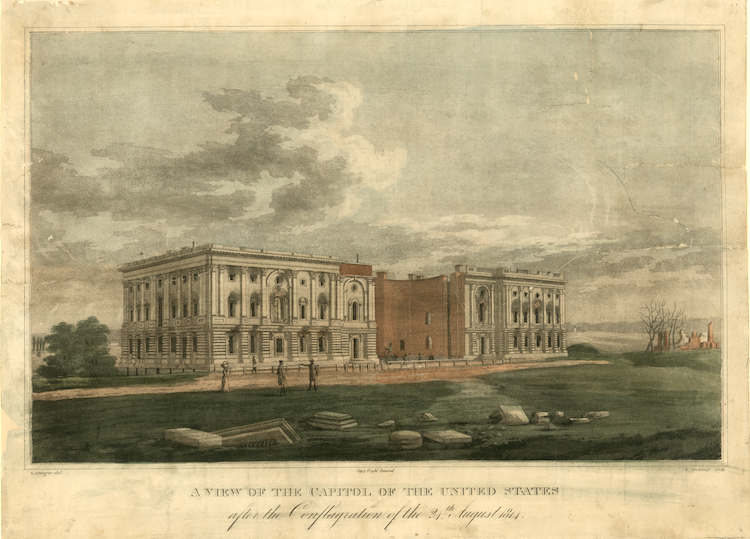
A View of the Capitol After the Conflagration of the 24th August 1814 https://www.whitehousehistory.org/photos/photo-5-3
That night, British troops burned the Capitol, the White House, and other buildings, including the State Department. Without Pleasonton’s quick thinking, prudence, and disregard for the naysayers, the original Declaration, Constitution, and other founding records might have gone up in flames, lost forever amid the humiliation of the capital’s burning.
Turning Eyewitness Words into Instant Patriotic Fuel
Just three weeks after Pleasonton rescued the Declaration from the flames, another powerful patriotic document was born. Francis Scott Key, detained on a British ship in Baltimore Harbor, watched the 25-hour bombardment of Fort McHenry. Moved by the sight of the American flag still flying at dawn, he drafted the poem “Defence of Fort M’Henry,” which would later become “The Star-Spangled Banner.”(17) He shared the verses with his brother-in-law, Judge Joseph H. Nicholson, a militia captain who had commanded artillery inside the fort during the battle.(18) Nicholson, fresh from the fight, recognized the poem’s power to lift morale in a time of war. He turned to fellow militiaman and printer Captain Benjamin Edes to rush the poem into broadsides, turning eyewitness words into instant patriotic fuel.
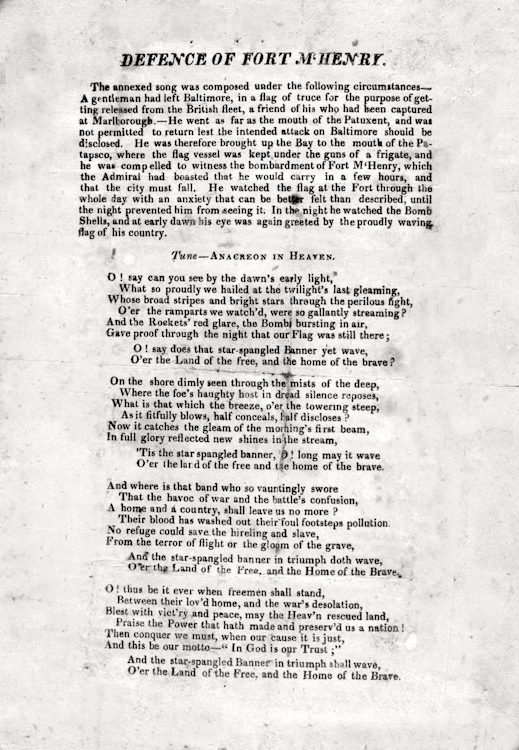
Defence of Fort M'Henry https://www.loc.gov/resource/music.musihas-100010457/
If that name sounds familiar, it’s because we discussed a printer by that name in the fourth part of our series, Events That Sparked the Grievances. This printer, though, was the grandson of the famous Boston Tea Party printer Benjamin Edes Sr., whose Boston Gazette had helped ignite the Revolution half a century earlier.
Within days, the Edes shop, with apprentice Samuel Sands handling the work while Captain Edes was on militia duty, produced the first anonymous broadside on September 17, 1814.(19) Soon, the poem was reprinted in newspapers and broadsides throughout the United States. Once again, the printing press, carried forward by a third-generation family of patriot printers, turned a personal eyewitness account into a national rallying cry almost overnight.
A few months later, the War ended quietly on Christmas Eve 1814. Though neither side actually “won,” Americans felt a sense of pride, having held their ground at Fort McHenry, and with Andrew Jackson’s victory at New Orleans. As the states were united against Britain, many Americans felt they had won the war and gained a “second independence.” A wave of national pride followed, which historians call the “Era of Good Feelings,” and helped bring the Declaration of Independence back into the spotlight.
The document, once nearly forgotten, resurfaced as a living symbol of America’s hard-won sovereignty. Newspapers reprinted its full text with renewed fervor, broadsides carried excerpts to taverns and town squares, and printers rushed to create the first elegant engraved facsimiles.
The Competition was Intense.
Two printers fiercely competed to print a commemorative edition of the Declaration. Benjamin Owen Tyler, working with engraver Peter Maverick, produced a version that emphasized elegant calligraphy and remarkably accurate reproductions of the signatures. John Binns took a more elaborate approach, surrounding the text with state seals and portraits of Hancock, Washington, and Jefferson in an ornate border.(20)
So how did they copy those 56 original signatures? In the early 1800s, before photography, they relied on old-school methods. Tyler, a professional penmanship teacher and calligrapher, personally hand-copied the entire text in elegant calligraphy. For the signatures, both Tyler and Binns most likely used a wet-transfer process, dampening paper and pressing it against the original parchment so some of the ink would lift off, then traced or engraved from that copy.(21) Tyler really emphasized accuracy. Acting Secretary of State Richard Rush, who was filling in until John Quincy Adams officially took office, certified that Tyler’s signatures were ‘curiously exact imitations.’(22) He also noted the effects of “the hand of time” on the original. A few months later, Secretary of State John Quincy Adams personally examined Binns’ version and certified that he had compared every signature and found them to be ‘Exact Imitations.’
The competition was intense. Binns was still refining his design when he submitted an unfinished proof to secure copyright. Tyler, however, reached the finish line first and published his engraving in 1818. Undeterred, Binns continued working and completed his much more ornate masterpiece in November 1819, more than three years after he first proposed the project.
The process of creating these facsimiles was tough on the original. Every time the parchment was dampened and pressed, a little more ink was pulled away. That’s one of the main reasons the signatures look so faded today.
Ironically, these efforts to promote the Declaration further accelerated its deterioration. Remember, it hadn’t been well cared for. During the Revolutionary War alone, the parchment was packed and unpacked at least eight to ten times as Congress fled advancing British forces. From Philadelphia to Baltimore, then back, then to Princeton, Annapolis, and Trenton. After the war, it was moved to New York City, the first capital of the United States. Then to Philadelphia, the temporary capital. It finally moved to Washington, D.C., but as we just learned, it was evacuated to Leesburg, Virginia. Then, back to Washington. During these trips, the parchment was usually rolled or folded to fit into trunks and boxes.(23)
Here’s an interesting fact: when it was rolled, they started from the top edge, the side with the large title and preamble. This meant the blank reverse side faced outward as the protective outer layer, shielding the inked text from abrasion, dust, and handling damage. On the back side, the reverse of the parchment, near the bottom edge, there is a handwritten inscription that reads:
“Original Declaration of Independence dated 4th July 1776”
This served as a handwritten label, so it would be visible on the outside of the rolled document, without having to unroll it every time someone needed to identify or retrieve the parchment.
By the 1820s, the ink had faded badly, and the signatures were barely legible. The parchment was creased and torn at the edges. Alarmed by the deterioration, Secretary John Quincy Adams commissioned engraver William J. Stone to create a true facsimile. While Tyler and Binns had made decorative copies mainly for public sale, Stone’s project was meant to be the most accurate reproduction possible.(24)
Working directly from the original parchment, Stone labored for three years, meticulously engraving a single copperplate. His process likely included elements of the wet-transfer method, which may have contributed to even more fading. From that copperplate, the State Department printed 200 official facsimiles on parchment in 1823 and distributed them to surviving signers’ families, officials, and libraries.
Here’s the kicker: the crisp, readable version of the Declaration we see in textbooks, posters, and replicas is not the original—it’s Stone’s 1823 engraving. The real parchment had become too faded and fragile to display regularly. Today, the original is preserved in special argon-filled cases at the National Archives. What most of us think of as “the Declaration” is actually a careful copy of a damaged document, made just in time for the 50th anniversary in 1826.
In 1826, the United States celebrated the semicentennial, the 50th anniversary of the Declaration of Independence, in what was widely called the “Jubilee.”(25) Celebrations exploded nationwide. Towns held parades featuring Revolutionary War veterans, some of whom marched in their faded old uniforms. Newspapers reprinted the full text of the Declaration, orators delivered speeches praising its principles, and ordinary citizens suddenly wanted to own and display the words that had first declared their nation free.(26)
In Washington, D.C., Mayor Roger Weightman invited all the surviving signers of the Declaration and all the living ex-Presidents. Adams and Jefferson fell into both categories. They replied, as did Charles Carroll of Carrollton, James Madison, and James Monroe. But none of them could attend the main events in the capital. While this was undoubtedly disappointing to the committee, the letters of regret, printed in the Washington newspapers on July 4th, were beautifully worded, and several contained sentiments well worth remembering.(27)
Jefferson, then 83 and in failing health, sent a poignant reply to Mayor Weightman. He expressed regret that “ill health forbids me the gratification of an acceptance,” and hoped the day would “forever refresh our recollections of these rights.”(28) John Adams, 90 years old and equally frail, also declined due to his health. In his response to local organizers, he included the now-famous toast: “Independence Forever!”(29) Charles Carroll of Carrollton, the only other surviving signer and then 89, attended some local festivities in Baltimore, where he lived, rather than traveling to Washington.
While the entire nation was joyfully celebrating the 50th anniversary of independence, Monticello lay quiet and still. Around noon on July 4, 1826, Thomas Jefferson took his last breath. Hours later, in Quincy, Massachusetts, just south of Boston, John Adams, the man who had fought so fiercely beside Jefferson for independence, also slipped away.
On the exact day America turned fifty, the two towering figures most responsible for its birth certificate left this world within hours of each other. The coincidence electrified the country. People saw it as nothing short of divine providence, a final, poetic seal on the story of the Declaration of Independence.
So the Declaration’s journey was a rollercoaster: a wartime thunderbolt, then decades of near-obscurity as the nation built its bones with the Articles of Confederation and the Constitution. Its ideas sparked revolutions abroad through the work of Jefferson, Lafayette, and Paine. Politics revived it in 1800, turning it into a creed, and the 1826 jubilee mythologized it amid those poignant deaths. Physically, it survived nomadic travels, a capital in flames thanks to Pleasonton, and well-meaning copyists who hastened its fade. Yet those core truths, equality, unalienable rights, and government by consent, endured, resurfacing when America needed reminding of its roots. In a way, its near-forgetting makes its revival all the more powerful.
1)Pages, R. (n.d.). July 4, 1776, First Independence Day: 5 Fast Facts You Need to Know | Warriors Renewal Coalition. https://warriorsrenewalcoalition.org/july-4-1776-first-independence-day-5-fast-facts-you-need-to-know/
2) Founding fathers’ blunders aged the declaration of independence. (2015, June 11). NBC News. https://www.nbcnews.com/science/science-news/founding-fathers-blunders-aged-declaration-independence-n148381
3) Brammer, R. (2019, November 15). Rare book video – The Articles of Confederation | In custodia legis. The Library of Congress. https://blogs.loc.gov/law/2019/11/rare-book-video-the-articles-of-confederation/
4) Articles of Confederation reprint by Gill Britannica Editors. (2026, February 27). Articles of Confederation | Summary, Date, & Facts. Encyclopedia Britannica. https://www.britannica.com/topic/Articles-of-Confederation
5) MHS Collections Online: U. S. Constitution (first printing) with annotations by Elbridge Gerry. (n.d.). https://www.masshist.org/database/viewer.php?item_id=2146&pid=17
6) Two versions of the Preamble to the Constitution, 1787 | Gilder Lehrman Institute of American History. (n.d.). https://www.gilderlehrman.org/history-resources/spotlight-primary-source/two-versions-preamble-constitution-1787
7) First printing | Center for the Study of the American Constitution | University of Wisconsin–Madison. (n.d.). https://archive.csac.history.wisc.edu/first_printing.htm
8) Pennsylvania Packet Page 4. (n.d.). https://content.libraries.wsu.edu/digital/collection/masc/id/325
9) Signed by order of the Society, B. Franklin, President. Philadelphia, 9th of November,. (n.d.). The Library of Congress. https://www.loc.gov/resource/rbpe.14701000/?st=text
11) https://thomaspaine.org/beacon/thomas-paines-role-in-the-french-revolution/
12) May Highlight: An Instrument which will Perpetuate the Fame of its Author | Declaration Resources Project. (2016, May 4). https://declaration.fas.harvard.edu/blog/may-propaganda
13) Washington, D.C. : U.S. G.P.O. : for sale by the Supt. of Docs., U.S. G.P.O., 1989. (n.d.). The Avalon Project : Jefferson’s first inaugural address. https://avalon.law.yale.edu/19th_century/jefinau1.asp
14) “P.S.: You had better remove the records.” (2024, September 10). National Archives. https://www.archives.gov/publications/prologue/2014/summer/war-of-1812-save-records
15) George Washington’s Mount Vernon. (n.d.). Dolley Madison Rescues George Washington. https://www.mountvernon.org/george-washington/artwork/dolley-madison-comes-to-the-rescue
16) White House Historical Association. (n.d.). Rescue of the Papers of State during the burning of Washington. WHHA (en-US). https://www.whitehousehistory.org/rescue-of-the-papers-of-state-during-the-burning-of-washington
17) Facts about the Star-Spangled Banner | Smithsonian Institution. (n.d.). https://www.si.edu/spotlight/flag-day/banner-facts
18) Francis Scott Key’s Poem Before It Became the Star Spangled Banner Rbsc, V. a. P. B. (2026, March 17). Francis Scott Key’s Poem Before it became the Star Spangled Banner – RBSC at ND. https://sites.nd.edu/rbsc/fourth-of-july-2018/
19) Poetry and Politics: Baltimore’s Small Presses Then and Now Stevenson University. (n.d.). Stevenson University. https://www.stevenson.edu/academics/undergraduate-programs/history/blog-news-events/poetry-and-politics-baltimores-small-presses-then-and-now/
20) Kratz, J. (2025, June 10). The BINN's engraving of the Declaration of Independence. Pieces of History. https://prologue.blogs.archives.gov/2022/07/01/the-binns-engraving-of-the-declaration-of-independence/
21) The Declaration of Independence and the hand of time. (2023, July 6). National Archives. https://www.archives.gov/publications/prologue/2016/fall/declaration
22) Letter from John Binns to Acting Secretary of State Richard Rush. (n.d.). https://catalog.archives.gov/id/68887972
23) “P.S.: You had better remove the records.” (2024, September 10). National Archives. https://www.archives.gov/publications/prologue/2014/summer/war-of-1812-save-records
24) The stone engraving: icon of the declaration. (2022, November 16). National Archives. https://www.archives.gov/publications/prologue/2003/fall/stone-engraving.html
25) Known as a “Jubilee” celebration... U.S. Department of War. (2026, February 20). Military supports semicentennial celebrations. https://www.war.gov/News/Feature-Stories/Story/Article/4370345/military-supports-semicentennial-celebrations/
26) Butterfield, L. H. “The Jubilee of Independence July 4, 1826.” The Virginia Magazine of History and Biography 61, no. 2 (1953): 119–40. http://www.jstor.org/stable/4245917.
27) University of Virginia Press. (n.d.). Founders Online: To Thomas Jefferson from Roger Chew Weightman, 14 June 1826. https://founders.archives.gov/documents/Jefferson/98-01-02-6163
28) Jefferson sent a poignant RSVP to Weightman... University of Virginia Press. (n.d.). Founders online: From Thomas Jefferson to Roger Chew Weightman, 24 June 1826. https://founders.archives.gov/documents/Jefferson/98-01-02-6179
29) University of Virginia Press. (n.d.). Founders online: July Fourth Toast by John Adams, 30 June 1826. https://founders.archives.gov/documents/Adams/99-02-02-8030