5 Things You Never Knew About the Declaration of Independence: The ‘Original’ Declaration
/The Declaration of Independence that most people picture, the one with John Hancock’s bold, sweeping signature surrounded by the autographs of the other delegates, the one with the date July 4, 1776, at the top, is a copy. Yes, that grand, engrossed parchment, now enshrined behind glass at the National Archives, the one that became the official record, wasn’t the first Declaration. There was another that actually announced independence to the world. What was it, and how did those revolutionary words first reach the people far beyond the State House doors?
Our story begins on the afternoon of July 4, 1776. Congress had finished drafting the language and had adopted the final text of the Declaration. A handwritten fair copy was prepared, probably by the Secretary of the Continental Congress, Charles Thomson, and his clerical staff. Once completed, a courier carried it out of the State House and stopped on the building’s steps. A small crowd of Philadelphians had gathered. There, the Declaration was read aloud for the first time, its words echoing over Chestnut Street.
Imagine their excitement on hearing the words:
“We hold these truths to be self-evident, that all men are created equal, that they are endowed by their Creator with certain unalienable Rights, that among these are Life, Liberty and the pursuit of Happiness.”
They must have been hanging on every word. Who read it? Likely Thomson’s senior clerk, Timothy Matlack. According to John Adams, Matlack had been a “principal orator” and had a powerful voice. One boy in the crowd, ten-year-old Anthony Morris, remembered Matlack’s delivery years later; a teenage girl nearby, Deborah Norris Logan, heard it clearly from her yard but couldn’t see the speaker. It was intimate, anxious, and bold, and that small group of ordinary people received the news first, before any grand ceremony. (1) Only after that impromptu reading did the fair copy reach John Dunlap’s print shop a few blocks away. There, the real, the “original” Declaration of Independence came to life.
Dunlap’s Print Shop
That afternoon, Dunlap, a 29-year-old Irish immigrant and the official printer to Congress, turned his shop into a whirlwind of activity. He, his typesetters, press operators, and bindery workers may have had some special visitors that day. As recorded in the Journals of the Continental Congress for July 4, 1776, Congress directed that “the committee appointed to prepare the declaration, superintend and correct the press.” (2)
It’s nice to think that at least one or two of the committee members were at Dunlap’s print shop that evening. Since Jefferson was the author of the Declaration, it’s quite likely that he was present. We have some evidence that may support this.
Let’s start with Dunlap’s printer’s proof. As printers, before a project goes to press, you make a proof. In colonial times and even today, when people do letterpress printing, we make a proof to check our spelling and spacing. We actually have a machine called a proof press. Today, before a job goes to press, people conduct a press check to ensure the colors are correct and that everything is spelled correctly. The same held true with Dunlap and the printing of the Declaration of Independence.
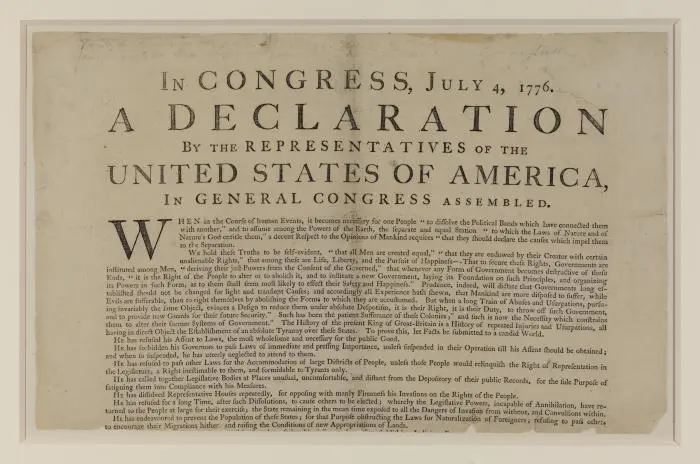
John Dunlap Declaration of Independence printer's proof, 1776.
Historical Society of Pennsylvania Treasures collection, DAMS #181 (https://hsp.org/education/primary-sources/john-dunlap-printing-declaration-independence)
The Historical Society of Pennsylvania has Dunlap’s printer’s proof. When you look closely at the document, you notice some marks that resemble quotation marks. These were set by the compositors, and they followed the words written on the fair copy. How and why were these on the fair copy? Well, earlier, we discussed that Matlack had read the declaration while standing on the steps of the State House. And, if he were to read the declaration as intended by its author, he would no doubt have consulted with the author who was sitting with him in the State House as he prepared the fair copy. These quotation marks were, in reality, diacritic marks created by Jefferson to indicate how the Declaration was to be publicly read. (3)
Jefferson was famously a terrible public speaker. He had a soft, low voice, almost a whisper, due to shyness and anxiety. He avoided public speaking whenever possible. Contemporary accounts describe him speaking in such a quiet tone that most of the audience couldn’t hear him clearly.
While Jefferson was poor at oratory, he was a diligent student of rhetoric, public speaking, and the art of reading aloud. He owned numerous books on these subjects. To compensate for his poor speaking skills, he developed these diacritical marks to indicate emphasis, pauses, rhythm, accent, timing, and cadence when reading a text aloud. Thus, it’s likely that Jefferson included those marks in the fair copy so that Matlack would add the proper emphasis when reading the document earlier that day.
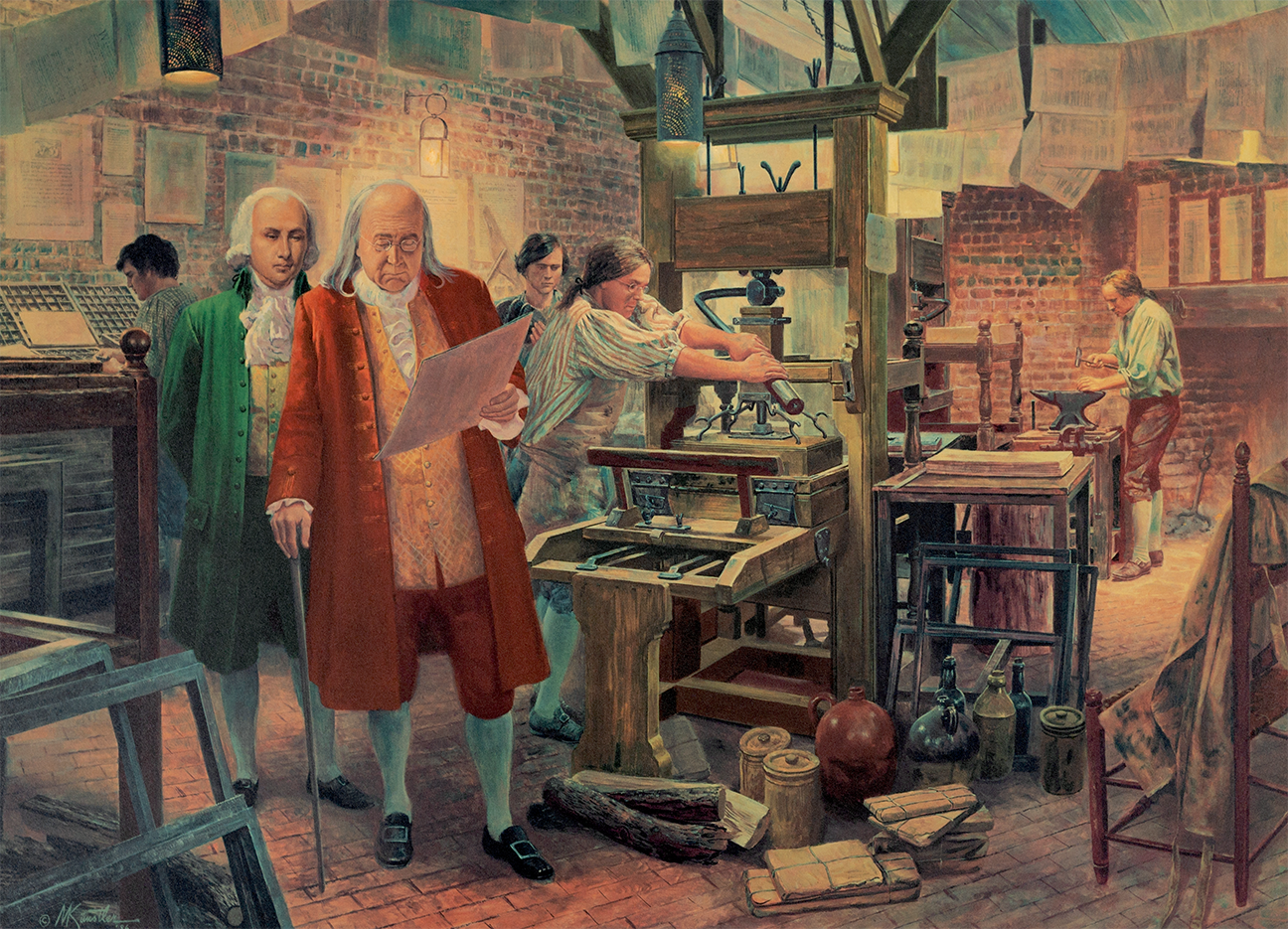
We, the People... 1787
The Printing Industry of the Carolinas,Mort Künstler, 1987 (https://www.mortkunstler.com/products/we-people1787-limited-edition-print)
In Dunlap’s final printing of the Declaration of Independence, these diacritical marks, the quotation marks, were removed. Thus, this may be evidence that Jefferson was present that night. He probably told the printers, “Wait a minute, those marks should not be there.” They were only there to help the speaker.
What about another of “the committee appointed to prepare the declaration”? Could Benjamin Franklin, the printer, have been on hand overseeing operations? It’s possible. Franklin’s favorite type font was Caslon. He was the first printer in the colonies to use Caslon. They used Caslon to typeset the declaration that night, and they needed a lot of Caslon. Dunlap’s compositors hand-set more than 1,320 words—nearly 7,800 letters and spaces. There’s evidence that at least three different sets of Caslon were used that night. (4) So, was Franklin, and a few cases of his type, there? We may never know.
And how did those compositors typeset nearly 7,800 characters in time for the pressmen to print 200 copies and prepare them for delivery by morning? Well, to move quickly, they used a standard printer’s trick. In colonial times, compositors would divide a long manuscript into small sections called “takes” and distribute them to several compositors working in parallel. These “takes” likely explain why historians cannot locate the original fair copy. It was probably cut up and scattered across type cases, and never reassembled. (5)
It was a busy time in the print shop that night. We know this because some copies were printed slightly slanted, and small errors were corrected mid-run. Many of the existing copies have ink on the back of the paper, offset, indicating they were printed but not left to dry before being folded in a hurry. The paper, too, shows the excitement in the shop. The watermarks on many of the extant copies are reversed. (6) Now, every quality printer knows to check and re-check the direction of the watermark on the paper stock before you run it through the press. So, these printers must have been in a hurry.
In addition to the watermark, there’s evidence of paper shortages. Sons of Liberty member and printer, Isaiah Thomas, had difficulty obtaining paper to print the account of the “shot heard 'round the world,” fired at Lexington and Concord at the beginning of the revolution. In fact, it was John Hancock who helped Thomas acquire the paper he needed. On the night of July 4, when Dunlap and his team were printing the Declaration of Independence, they used whatever stock they had available, as evidenced by surviving copies that exhibit a variety of watermarks and sources. And some of the paper was really nice.
Most of the paper used that night was fine Dutch paper, marked with elegant crown-and-posthorn designs that varied slightly from mill to mill. Many carried the letters “GR,” linked to the respected L.V. Gerrevinck mill. Thomas Jefferson used this brand of paper to take early notes on the Virginia Constitution. The Declaration of Independence at the National Historical Park has the watermark of an important Dutch papermaking family that began making paper in 1621. The Dutch father-and-son papermakers, Dirk and Cornelis Blauw, operated five wind-powered papermills in North Holland and survived for more than 250 years under various names. Historians have called them “perhaps the most important of all Dutch papermakers.” (7)
This paper was of such high quality and had such a strong reputation that James Whistler, the artist who painted Whistler’s Mother, used it to print some of his etchings. (8)
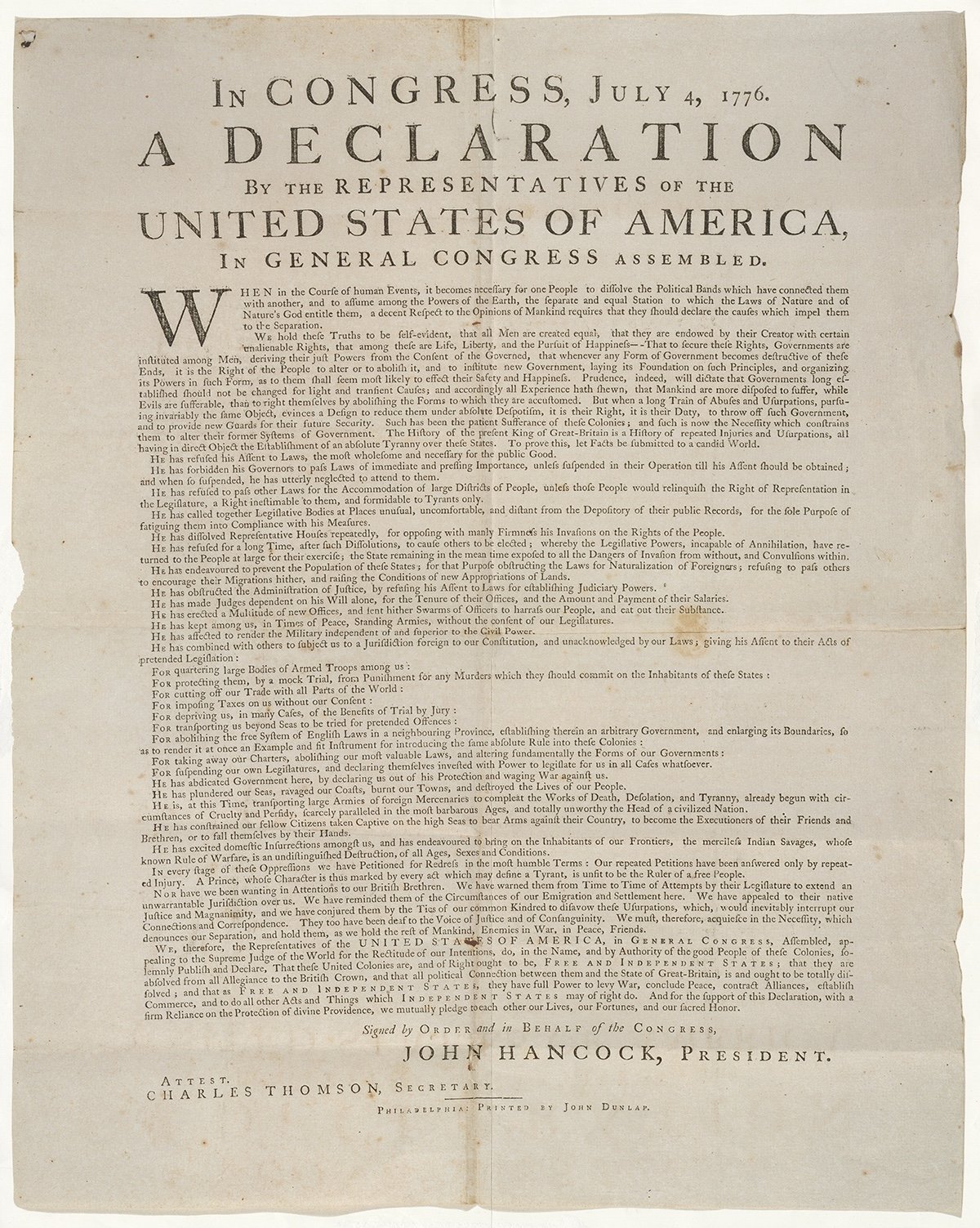
Dunlap Declaration of Independence, July 4, 1776 (https://www.loc.gov/item/2003576546/)
By morning, roughly 200 broadsides were ready. Riders carried them immediately to state assemblies, army camps, and towns across the colonies.
This Dunlap broadside, not the later signed parchment, was the “original” declaration that announced independence to the world. And, it carried Dunlap’s name boldly at the bottom, Philadelphia: Printed by John Dunlap, a risky act in an era when printing such words could be seen as treason. In an era when the British Crown had declared the rebellion treasonous, putting his name on such a document was a dangerous act of defiance. If British forces or Loyalists had captured him, Dunlap would have been treated as a traitor, facing the same fate as other signers who fell into their hands.
Richard Stockton of New Jersey provides a grim illustration. In late 1776, Loyalists dragged Stockton from his bed at night, stripped him, looted his home, and delivered him to British custody. Confined in the Provost Jail in New York, notorious for poor treatment, overcrowding, and the death of prisoners, he endured extreme cold, long periods without food, and harsh treatment that left lasting damage. Even after his release in 1777, he never fully recovered his health. His large library, which was one of the best in private hands at the time, was burned, his domestic animals, including his horses, and nearly all personal property were stolen or destroyed, and his farm was laid waste. The losses forced him to rely on friends for basic necessities. The ordeal ruined his health and spirits. He suffered from a long illness that ended in cancer, so painful that he needed constant medicine for relief. He died on February 28, 1781, at his home, at age fifty-one.
Before the war, Stockton had been a respected figure: a clear and forceful speaker with strong reasoning; a skilled and knowledgeable lawyer whose judgment was widely respected. The contrast between his earlier standing and his post-capture suffering shows the real danger Dunlap faced by openly printing and claiming the Declaration. In British eyes, both the signer and the printer who spread the treasonous words were equally guilty, and the consequences, imprisonment, property destruction, and ruined health, could be devastating.
One curious detail of Dunlap’s Declaration that most people don’t notice is the number of lines of type from top to bottom; they total exactly 76. Was this a nod to the year 1776, or just pure coincidence?
The Dissemination of the Declaration
Despite members of Congress having taken oaths of secrecy, news had already begun leaking before the official printing. The Huntington Library holds a July 2 issue of the Pennsylvania Evening Post that boldly proclaimed, two days before Congress had finalized the text, the colonies “free and independent states.” Right beside that announcement are advertisements offering rewards for the return of an escaped enslaved man named Ishmael and another for a runaway apprentice and his mother. (9) The irony is stark and painful.
The Declaration reached Pennsylvania’s large German-speaking population almost immediately. At the time, nearly a third of the colony’s residents spoke German as their first language. On July 5, 1776, Johann Heinrich Miller, a 50-year veteran of the newspaper business and former employee who worked as a printer for Benjamin Franklin, announced in his Pennsylvanischer Staatsbote the existence of the new Declaration. (10) It read:
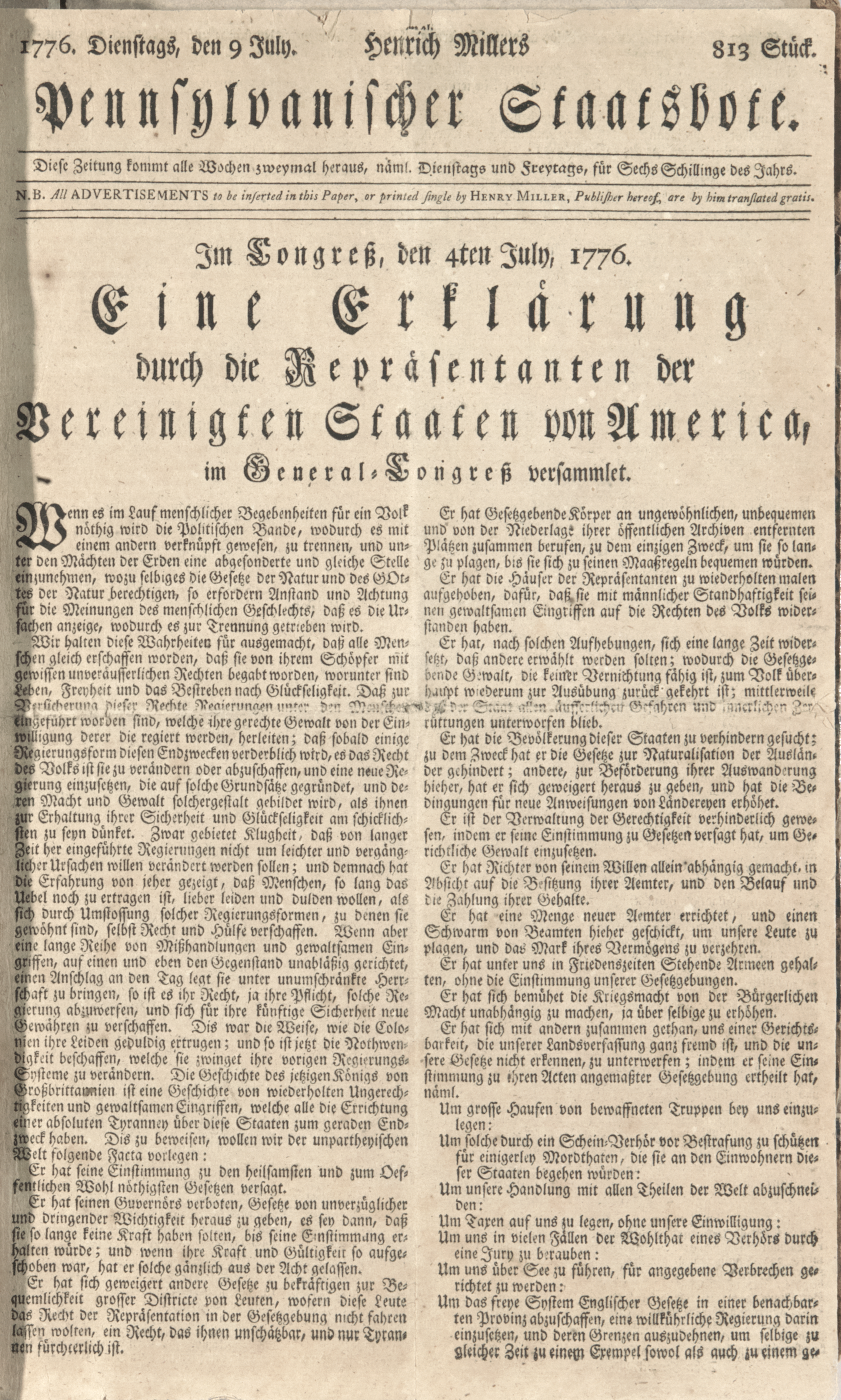
Der Wöchentliche Philadelphische Staatsbote, July 9, 1776
Historical Society of Pennsylvania Treasures collection, DAMS #10601. 1 (https://digitallibrary.hsp.org/index.php/Detail/objects/10601)
Original:
“Gestern hat der Achtbare Congreß dieses Westen Landes die Vereinigten Colonien Freye und unabhängig Staaten erkläret. Die Declaration in Englisch ist jetzt in der Presse; sie ist datirt, den 4ten July, 1776, und wird heut oder morgen im druck erscheinen.”
Translation:
“Yesterday, the honorable Congress of these Western Lands, declared the United Colonies free and independent states. The Declaration is in English and is now at the Press; it is dated July 4th, 1776, and will be published either today or tomorrow.”
The next day, July 8th, German printers Melchior Steiner and Carl Cist published a broadside containing the translation. (10) They appear to have been working with Miller, because the next day, on July 9, Miller published his version of the German translation of the Declaration in his newspaper, which closely resembled Steiner and Cist’s version. In this way, thousands of German American families could read the words of independence in their own language. (11, 12)
On July 6, 1776, John Hancock sent General George Washington a letter enclosing one of the freshly printed Dunlap broadsides. In it, Hancock asked Washington to have the document read to the troops.
Impressed with this Sentiment, and at the same Time fully convinced, that our Affairs may take a more favourable Turn, the Congress have judged it necessary to dissolve the Connection between Great Britain and the American Colonies, and to declare them free & independent States; as you will perceive by the enclosed Declaration, which I am directed to transmit to you, and to request you will have it proclaimed at the Head of the Army in the Way, you shall think most proper. (13)
Three days later, on July 9, Washington issued orders:
The several brigades are to be drawn up this evening on their respective Parades, at six OClock, when the declaration of Congress…is to be read with an audible voice. (14)
At the time, morale was low because British troops had landed on Staten Island and an invasion was imminent. Washington used the reading to rally his soldiers and reinforce their commitment now that independence had been declared. It worked. The reading sparked three hearty huzzas from the troops, and the excitement spilled into the streets, where a crowd pulled down the lead statue of King George III at Bowling Green. That statue was later melted down into musket balls for the fight ahead. (15)
Unlike the troops, most Americans first encountered the Declaration of Independence through newspapers or printed broadsides, either reading the text themselves or hearing it read aloud. The very first newspaper to publish it appeared on July 6, 1776, in Benjamin Towne’s Pennsylvania Evening Post. From there, the words spread quickly. (16)
In the following days and weeks, the Declaration was printed in newspapers across the nation.
Historians estimate around 24–30 printings by late July.
While not exhaustive, the list below includes many of the newspapers printed by late July in 18+ towns.
July 4–5, 1776: John Dunlap (Philadelphia) prints the first broadsides (~200 copies). These are the master copies sent out to governors, assemblies, and the army.
July 6, 1776: Benjamin Towne publishes the first newspaper printing in the Pennsylvania Evening Post (Philadelphia). This is the earliest appearance in any newspaper.
July 8, 1776: John Dunlap prints it in his own newspaper, Dunlap’s Pennsylvania Packet or the General Advertiser (Philadelphia).
July 9, 1776: Heinrich Miller prints a full German translation in the Pennsylvanischer Staatsbote (Philadelphia), aimed at Pennsylvania's large German-speaking community.
July 10, 1776: The Declaration appears in the Pennsylvania Gazette (Philadelphia) and Pennsylvania Journal (Philadelphia); Maryland Journal and the Baltimore Advertiser
July 11, 1776: Printings begin in other states, including the Maryland Gazette (Baltimore/Annapolis area) and possibly early New York papers.
July 12, 1776: The Connecticut Gazette (New London, Connecticut) prints it.
July 13, 1776: The Pennsylvania Ledger (Philadelphia) finally includes it (delayed by its weekly schedule).
July 15, 1776: The Connecticut Courant and Hartford Weekly Intelligencer (Hartford) and Norwich Packet (Norwich, Connecticut) print it.
July 16, 1776: Robert Luist Fowle prints it in the New Hampshire Gazette (Exeter, New Hampshire) and as a separate broadside (though Fowle was a Loyalist, he still ran the text).
July 17, 1776: The Connecticut Journal (New Haven, Connecticut) and possibly the Massachusetts Spy (Worcester, Massachusetts) include it.
July 18, 1776: Boston papers like the Continental Journal (Boston), operated by John Gill, print it, coinciding with the public reading there from the balcony of the Old State House.
July 19–20, 1776: In Williamsburg, Virginia, the Virginia Gazette (both Dixon & Hunter and Alexander Purdie editions) prints the full text.
July 26, 1776: Another Virginia Gazette issue (Purdie) reprints it, as ordered by the Privy Council.
By the end of July 1776, the Declaration had been reprinted in newspapers from New Hampshire to Virginia, often in multiple issues per town. The spread was incredibly rapid for the time.
The Goddard Broadside
Probably the most important printed broadside of the Declaration, besides Dunlap’s, was printed by a female colonial printer who operated a print shop in the 1770s. Mary Katharine Goddard learned the printing trade from her younger brother William, who started a printing business in Providence, Rhode Island. As a family, William, Mary Katharine, and their mother, Sarah, ran the Providence Gazette and Country Journal from the basement of their house. When referring to Mary Katharine, Isaiah Thomas, “She was an expert and correct compositor of types…”(16)
As a side note, the image many have thought to be Mary Katharine is, in fact, that of Anne Brunton Merry (1769-1808). No known image of Mary Katharine Goddard exists. (17)
The first issue of the family’s paper appeared on October 20, 1762. This was the first successful newspaper in Providence, and it was consistently published weekly, with only minor interruptions, for decades until about 1795, though under various owners.
Later that year, William left for Philadelphia, while Mary and Sarah stayed and published the paper under the name “Sarah Goddard and Company.” The mother-daughter team eventually sold the Providence Gazette and joined William in Philadelphia. After their mother died in 1770, both William and Mary Katharine wound up in Baltimore.
While in Baltimore, William started a new publication, the Maryland Journal and Baltimore Advertiser, but soon shifted his focus to working with Benjamin Franklin on building the colonial postal system in 1774. (18) Mary Katharine Goddard assumed editorial control of the paper and continued publishing it under her own name. The colophon on the paper changed on May 10, 1775; it read: “Baltimore: Published by M.K. Goddard, at the Printing-Office in Market-Street, next Door above Dr. John Stevenson’s.” She managed it successfully for the next decade, even through the Revolution, when paper and ink were scarce. On July 10, 1776, just six days after Congress adopted the Declaration, she printed the full text in The Maryland Journal. (19)
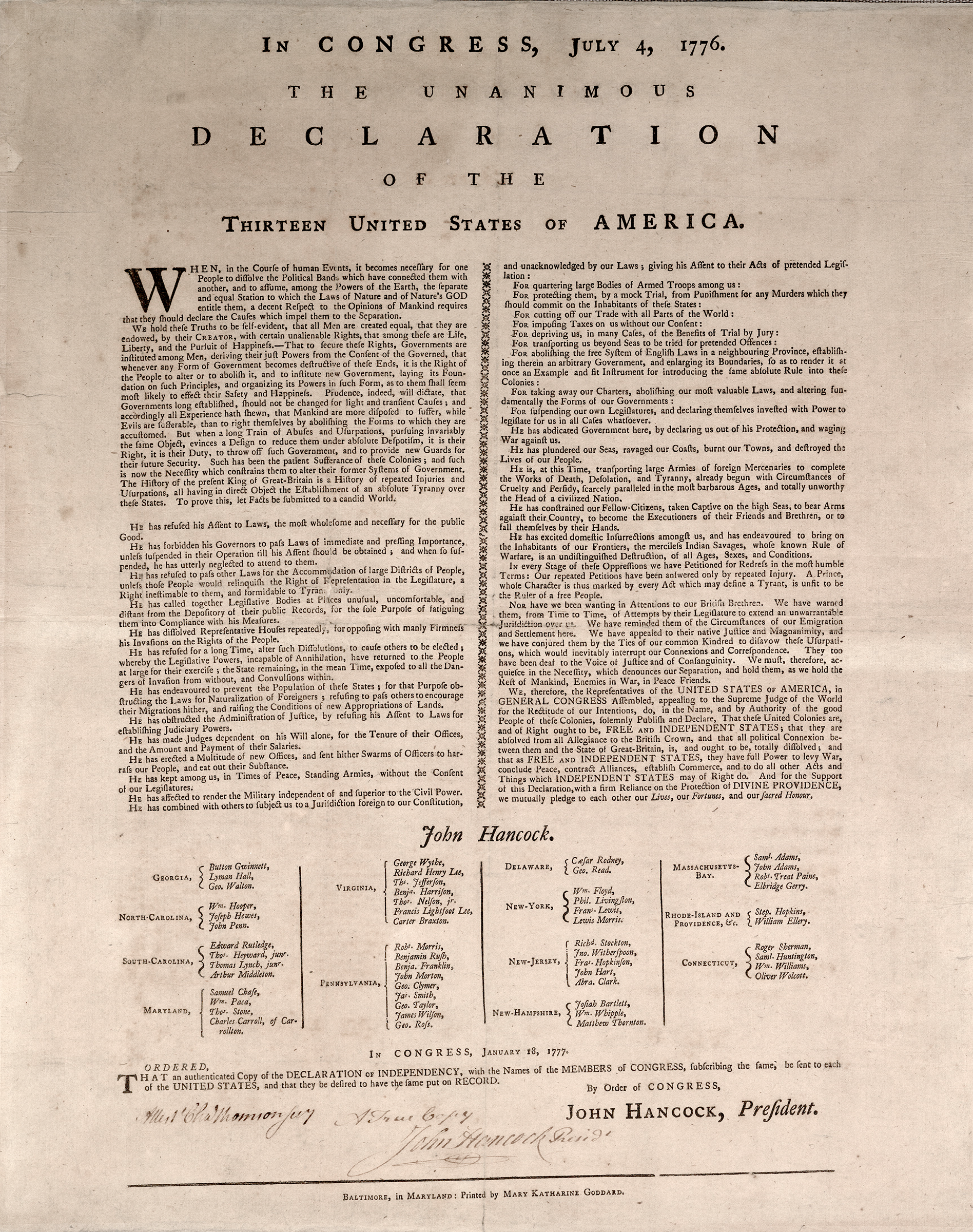
Mary Katharine Goddard first printed the names of the signers of the Declaration of Independence in January 1777 (https://www.loc.gov/item/90898037/)
The Goddards were true patriots. Early in his career, William purchased one of the first printing presses to be “made in America.” The machine, manufactured by Isaac Doolittle, was a beautiful mahogany printing press, “the neatest ever made in America and equal, if not superior to any imported from Great-Britain.” (20) As a printer, he was critical of the Stamp Act and published an article on the controversy in his paper. Soon after, he joined the Sons of Liberty.
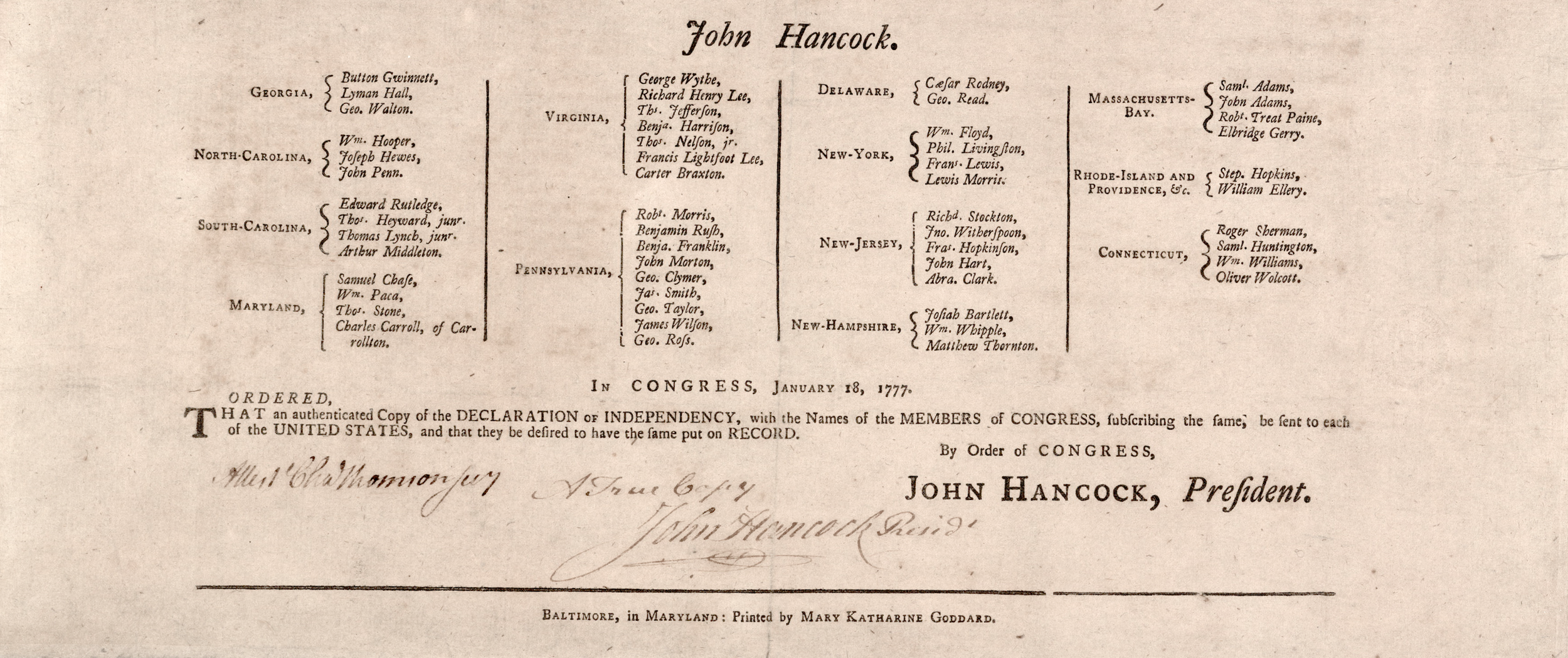
As for Mary Katharine, in January of 1777, she added her name to the list of signers of the declaration, not as a delegate to the convention, but as the printer of the “authenticated copy” that had been ordered by the Continental Congress. For two weeks, she printed the broadsides, the first to include a list of the signers’ names. And, as Dunlap did, she included her full name at the bottom of the document, Baltimore, in Maryland: Printed by Mary Katharine Goddard, not simply her initials, as was found on her newspapers and other printed documents. (21)
Actively supporting the Revolution by printing those broadsides was considered high treason under British law, punishable by death, including hanging, drawing, and quartering. She was fully aware of George III’s 1775 Proclamation of Rebellion, which declared the colonists in rebellion and authorized military action against leaders. She was also undoubtedly aware of the experience of Elizabeth Lewis, a few months earlier, at the hands of the British in the autumn of 1776.
Elizabeth was the wife of New York signer Francis Lewis, who suffered greatly when British troops looted and destroyed their Long Island home along the East River, while her husband was away in Philadelphia.
According to accounts of the raid on the Lewis estate, the British troops were sent “to seize the lady and destroy the property.” As the soldiers advanced from one side of the house, a warship fired cannonballs from the other. A shot hit a board Elizabeth was standing on. One of her servants shouted, “Run, mistress, run.” She simply replied, “Another shot is not likely to strike the same spot,” and stood her ground; she didn’t move. As some soldiers entered the house and destroyed books, papers, pictures, and furniture, another threw himself at her feet and tore the buckles from her shoes. He thought they were gold, but they weren’t. Elizabeth looked down and said, “All is not gold that glitters.”
Within minutes, she was arrested. At the time, she was in her late fifties and already in poor health. They took her to prison in New York City, where she was held for months with no bed, limited food, and inadequate clothing, and she was not allowed to communicate with anyone outside. In that damp, filthy prison, Elizabeth became very ill. But she had a “guardian angel.” According to reports, an old family servant had followed her to the city, found out where she was, smuggled in small items of clothing and food, and delivered letters to her friends.
After nearly three months, she was released through a prisoner exchange arranged by General Washington. According to family accounts, just after her release, her “guardian angel” fell seriously ill. As a Roman Catholic, he wanted his last rites before he died, but a priest in New York, under martial law, was impossible to find. So Elizabeth sent a messenger to Philadelphia, who found a priest and smuggled him through the British lines just in time to administer the last rites; the man passed away peacefully.
Elizabeth’s health never recovered. She contracted a fever that developed into lingering consumption, and she died in June 1779, within a few years of her release, all because of her husband’s signature on the Declaration.
As a side point, that 1775 Proclamation of Rebellion was printed by Charles Eyre and William Strahan, who held the royal patent as King’s Printers in London. Eyre started his business in 1739. His partnership with Strahan was formalized in 1770, and the company survived in various forms through family succession, mergers, and consolidations for over 250 years. It remained a major London printer and publisher of Bibles and government publications through the mid-20th century, before being absorbed into larger publishing groups by the end of the century. (22)
As for Mary Katharine Goddard, she never married and had no children. When she died on August 12, 1816, she freed her enslaved woman, Belinda Starling, and left her everything she owned. In her will, Goddard wrote that she “give[s] and grant[s] to my female slave, Belinda Starling, aged about 26 years, her Freedom at my death; and I also give and bequeath unto said Belinda Starling all the property of which I may did posessed; all which I do to recompense the faithful performance of duties to me.” (23)
Dunlap, too, showed his true patriotism. He didn’t stay behind the press forever. Five months after printing the Declaration of Independence, in December 1776, Lieutenant John Dunlap rode out with the First Troop Philadelphia City Cavalry, a volunteer unit, of which he was a founding member, to serve as General Washington’s personal bodyguard during the Trenton and Princeton campaigns. On 25 December, the Troop crossed the icy Delaware River during Washington’s famous crossing. (24) Once at Trenton, in the thick of one of the war’s turning-point victories, Dunlap led a detachment that demanded, and received, the surrender of Hessian soldiers.
The Declaration didn’t start with elegant signatures on parchment. It began with the smell of wet ink, the “pick and click” of type being set, and the courage of printers who risked everything to spread the word. That’s the story the presses still tell us today—a reminder that print didn’t just record the Revolution; it helped shape it. Those newspapers and broadsides of the Declaration of Independence made it real for the people of the 13 colonies.
Sources
1. Chris Coelho, “The First Public Reading of the Declaration of Independence, July 4, 1776,” Journal of the American Revolution, July 1, 2021, https://allthingsliberty.com/2021/07/the-first-public-reading-of-the-declaration-of-independence-july-4-1776/
2. Worthington Chauncey Ford, ed., JOURNALS OF THE CONTINENTAL CONGRESS 1774-1789, vol. Volume V (GOVERNMENT PRINTING OFFICE, 1906), https://tile.loc.gov/storage-services/service/ll/llscd/lljc005/lljc005.pdf
3. Max Marin, “The First Declaration of Independence Was Printed by a 29-year-old Immigrant,” Billy Penn at WHYY, January 17, 2023, https://billypenn.com/2019/07/04/this-29-year-old-immigrant-printed-the-first-declaration-of-independence
4. “Printing and Type in the Revolutionary Era,” Penn Libraries, n.d., https://www.library.upenn.edu/events/typography-independence/makers-blog/printing-and-type
The Typesetting and Designs of the Declaration of Independence Broadsides, Craig Welsh, Associate Professor of Communications & Humanities, Penn State Harrisburg https://youtu.be/PY0ND0sZl1E?si=ukI4mGg3qlXsydjN
5. Chris Pomar, “Proclaiming Independence | the Huntington,” n.d., https://www.huntington.org/verso/proclaiming-independence.
6. “John Dunlap Prints the First Copies of the Declaration of Independence: History of Information,” n.d., https://www.historyofinformation.com/detail.php?id=425
7. Listings. (n.d.). National Gallery of Australia. https://nga.gov.au/art-artists/conservation/paper/listings-watermark-and-countermark-library/
8. Rotherhithe (Wapping), from the Thames Set (A Series of Sixteen Etchings of Scenes on the Thames and Other Subjects) Yale University Art Gallery. (n.d.). Yale University Art Gallery. https://artgallery.yale.edu/collections/objects/39429
9. Chris Pomar, “Proclaiming Independence | the Huntington,” n.d., https://www.huntington.org/verso/proclaiming-independence.
10. Rotherhithe (Wapping), from the Thames Set (A Series of Sixteen Etchings of Scenes on the Thames and Other Subjects) Yale University Art Gallery. (n.d.). Yale University Art Gallery. https://artgallery.yale.edu/collections/objects/39429
11. Will Christman, “The Declaration of Independence: In German!,” Historically Speaking, September 7, 2018, https://vugradhistory.wordpress.com/2018/09/07/the-declaration-of-independence-in-german/.
12. The United States Declaration of Independence (Part 4). (n.d.). https://www.dhm.de/archiv/magazine/unabhaengig/adams4_d.htm#staatsbot
13. University of Virginia Press. (n.d.). Founders online: John Hancock to George Washington, 6 July 1776. https://founders.archives.gov/documents/Washington/03-05-02-0153
14. University of Virginia Press, “Founders Online: General Orders, 9 July 1776,” n.d., https://founders.archives.gov/documents/Washington/03-05-02-0176.
15. Boys, Bowery. “George Washington’S Copy of the Declaration of Independence.” The Bowery Boys: New York City History, July 4, 2022. https://www.boweryboyshistory.com/2022/07/george-washingtons-copy-declaration-independence.html.
16. “The History of Printing in America, With a Biography of Printers : Thomas, Isaiah, 1749-1831 : Free Download, Borrow, a7d Streaming : Internet Archive,” Internet Archive, 1874, https://archive.org/details/historyofprintin01thom/page/328/mode/2up.
17. March Highlight: Mary Katharine Goddard | Declaration Resources Project. (2016, March 4). https://declaration.fas.harvard.edu/blog/march-goddard
18. History of the United States Postal Systems https://wayback.archive-it.org/all/20120427192543/http://inventors.about.com/library/inventors/blmailus1.htm#COLONIAL
19. First Newspaper Printing of the Declaration of Independence https://www.amrevmuseum.org/collection/first-newspaper-printing-of-the-declaration-of-independence
20. Carl Bridenbaugh, “The Press and the Book in Eighteenth Century Philadelphia,” 1941, https://journals.psu.edu/pmhb/article/view/29658. p.3
21. “March Highlight: Mary Katharine Goddard | Declaration Resources Project,” March 4, 2016, https://declaration.fas.harvard.edu/blog/march-goddard
22. Essex Archives Online - Catalogue: D/F 182. (n.d.). https://www.essexarchivesonline.co.uk/Result_Details.aspx?DocID=90243
23. “Mary Katharine Goddard, MSA SC 3520-2809,” n.d., https://msa.maryland.gov/megafile/msa/speccol/sc3500/sc3520/002800/002809/html/2809bio.html#3.
24. Admin, “First Troop Philadelphia City Cavalry,” The Army Historical Foundation, April 29, 2024, https://armyhistory.org/first-troop-philadelphia-city-cavalry/.